
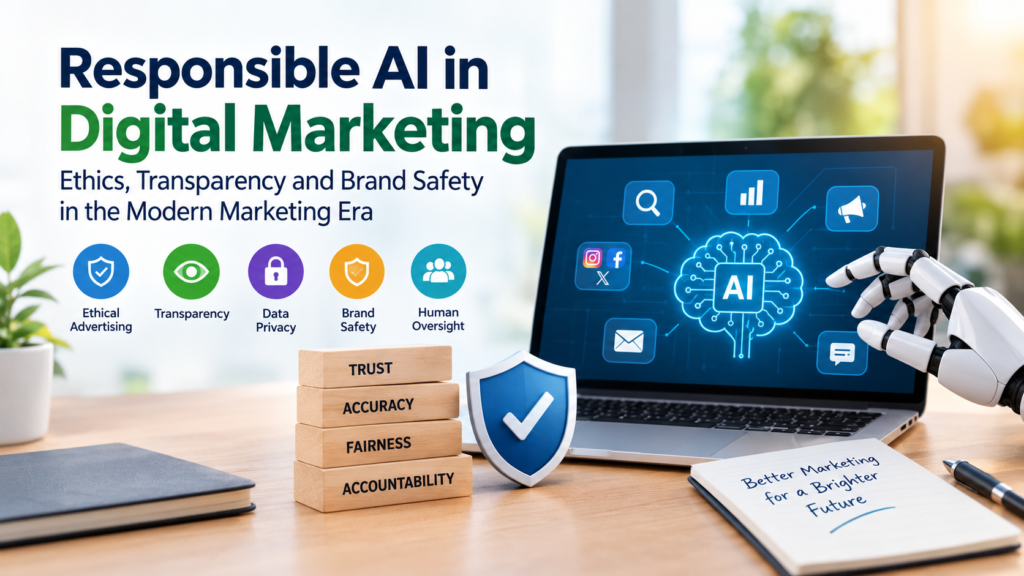
Introduction: Why Responsible AI Matters in Digital Marketing
Artificial intelligence is changing how businesses create content, manage advertising campaigns, analyze customer behaviour, and communicate with audiences. From AI-assisted search engine optimization to automated social media campaigns, marketers now have access to tools that can reduce repetitive work and support faster decision-making. However, using these tools effectively requires more than technical knowledge. Marketers must also understand transparency, data privacy, fairness, and brand safety. People exploring an online digital marketing course can learn about the wider digital marketing skills needed to understand these changes, while DG Mark Institute is one learning resource to explore when considering digital marketing education. Understanding responsible AI is valuable for students, professionals, freelancers, and businesses that want to use automation without compromising customer trust.
The growing use of AI creates an important question: how can marketers benefit from technology while remaining honest, accountable, and respectful of their audiences?
The answer is not to avoid AI completely or allow it to make every decision. Instead, marketers need a balanced approach that combines automation with human judgment. AI can help identify patterns, generate ideas, and organize information, but people remain responsible for checking the accuracy, fairness, and suitability of the final output.
This article explores responsible AI in digital marketing, explains the ethical challenges businesses should understand, and presents practical ways to protect customer trust and brand reputation.
1. Understanding Responsible AI in Digital Marketing
Responsible AI refers to the thoughtful development and use of artificial intelligence in ways that consider accuracy, fairness, privacy, transparency, security, and accountability.
In digital marketing, this means using AI tools to support business objectives without misleading customers, misusing personal information, spreading false claims, or creating unfair advertising experiences.
AI can contribute to several marketing activities, including:
- Generating content ideas and drafting articles.
- Identifying search trends and keyword opportunities.
- Analyzing campaign performance.
- Supporting audience segmentation.
- Automating routine email marketing tasks.
- Suggesting social media captions and creative concepts.
- Assisting with customer service and chatbots.
- Identifying unusual changes in advertising performance.
These applications can save time, but they also introduce risks. An AI-generated article might contain incorrect information. An advertising system might deliver ads unevenly across audience groups. A chatbot might promise something a company does not offer.
Responsible AI practices help marketing teams identify and reduce these risks before they affect customers.
AI is a tool, not a replacement for accountability
One of the most common misunderstandings about AI is that automated output can be trusted simply because it appears confident or professional.
AI systems can produce convincing statements that are incomplete, outdated, or inaccurate. They may also reflect biases present in their training data or the information provided to them.
For example, a marketer might ask an AI writing assistant to prepare a blog about the benefits of an online marketing service. The tool could produce a polished article containing unsupported claims about guaranteed business growth.
The writing may sound credible, but that does not make the claims true.
A responsible marketer checks the information, removes unsupported promises, and ensures the content accurately represents the service.
The principle is straightforward: automation can assist with execution, but responsibility for published marketing remains with the people and organizations involved.
2. Why Ethics Has Become Important in Modern Marketing
Digital marketing depends heavily on customer attention and trust. Businesses use websites, search engines, social media, email, and paid advertising to build relationships with potential customers.
When customers believe that marketing messages are honest and relevant, they are more likely to engage with a brand. Misleading communication, invasive targeting, or fabricated content can damage that relationship.
AI makes these concerns more significant because it allows marketers to produce and distribute content at greater speed and scale.
A single person can use AI to generate dozens of advertisements, hundreds of social media ideas, or multiple article drafts in a short period. Without suitable checks, mistakes can spread across several channels before anyone notices them.
Ethical AI practices help businesses address four important concerns.
Accuracy: Marketing messages should be based on reliable information rather than unsupported AI-generated statements.
Fairness: Automated systems should be monitored for discriminatory outcomes and inappropriate audience exclusions.
Transparency: Customers should not be deliberately misled about a product, service, recommendation, or synthetic representation.
Accountability: Businesses should establish who reviews AI output, approves campaigns, and responds when something goes wrong.
These principles are relevant to companies of every size. A small business using an AI chatbot faces different operational challenges from a large advertising agency, but both need to consider the consequences of automated communication.
Ethical marketing is not simply about avoiding public criticism. It is about developing practices that respect customers while supporting sustainable business growth.
3. How AI Is Transforming Different Areas of Digital Marketing
To use AI responsibly, marketers need to understand where it fits into their daily work.
AI in search engine optimization
AI tools can assist with keyword research, topic clustering, content planning, search-intent analysis, and identifying opportunities to improve existing pages.
For example, an SEO professional could use an AI assistant to organize keywords related to digital marketing education into categories such as beginner training, career development, advertising skills, and search engine optimization.
The resulting structure can help the professional develop a more organized content plan.
However, AI-generated keyword suggestions should not automatically be treated as verified search-volume data. Marketers should use appropriate research tools to check demand and evaluate whether a topic matches the audience’s needs.
AI-generated articles also require editorial review. Content should provide useful information, answer real questions, and demonstrate appropriate knowledge of the subject.
Publishing large amounts of repetitive material simply because it is easy to generate can produce poor results for readers. Search optimization should focus on relevance, usefulness, originality, and accuracy rather than volume alone.
AI in content marketing
AI can help writers brainstorm headlines, create outlines, summarize research, and explore different ways of explaining a complex topic.
A content team might use AI to prepare an initial outline for an article about responsible advertising. An experienced writer can then add examples, verify claims, improve the structure, and ensure the article reflects the publication’s editorial standards.
This approach uses AI to support the writing process rather than treating its first draft as a finished product.
Content creators should also pay attention to copyright, originality, factual reliability, and the use of third-party material. AI output should not be assumed to be original, legally safe, or factually correct without appropriate review.
AI in Google Ads and paid advertising
Advertising platforms already use automation to support bidding, targeting, optimization, and campaign delivery.
AI-assisted tools can also help marketers generate advertising headlines, descriptions, creative variations, and ideas for audience messaging.
These capabilities can improve efficiency, but automated recommendations still need human oversight.
Suppose a marketer uses AI to write an advertisement for a professional training course. The system generates a headline claiming that every student will receive a high-paying job immediately after completing the course.
If that claim is unsupported, publishing it could mislead potential students and create reputational or compliance risks.
The marketer should replace it with accurate information about the learning opportunity and avoid guarantees that cannot be substantiated.
Advertising teams should regularly review landing pages, creative assets, targeting choices, and campaign performance rather than assuming that automated optimization always produces suitable outcomes.
AI in social media marketing
Social media professionals can use AI to generate post ideas, suggest captions, organize calendars, and adapt content for different platforms.
However, the same message may not be appropriate for every audience or situation.
A humorous post might be suitable for an entertainment brand but inappropriate during a sensitive public event. An automatically generated response might also sound dismissive when a customer is discussing a serious complaint.
Human review helps ensure that content reflects the brand’s tone, audience expectations, and current circumstances.
AI in email marketing
AI can help marketers personalize email subject lines, organize customer segments, and identify suitable communication times.
Nevertheless, personalization should not become an excuse for intrusive data use.
Businesses should use customer information appropriately, respect consent and communication preferences, and follow applicable privacy requirements. They should also avoid making sensitive personal assumptions based on limited data.
A relevant email that helps a customer understand a service can be useful. A message that appears to know private details the customer never knowingly shared may create discomfort and reduce trust.
4. Transparency: Helping Customers Understand Marketing Messages
Transparency means communicating honestly about what a business offers, how it represents its products, and when the use of AI is relevant to a customer’s understanding of the message.
Not every AI-assisted marketing activity requires a public disclosure. Using AI to brainstorm keywords or correct grammar is different from publishing a realistic synthetic video of a person appearing to endorse a product.
The appropriate level of transparency depends on the context, the potential for confusion, applicable rules, and the policies of the platform being used.
When should marketers consider disclosing AI use?
Disclosure deserves particular attention when AI substantially changes how audiences might interpret content.
Examples include:
- Realistic synthetic images that could be mistaken for genuine photographs.
- AI-generated videos showing people making statements they never made.
- Virtual influencers presented in ways that could confuse audiences.
- Synthetic voices that imitate real people.
- Fabricated customer testimonials or product demonstrations.
- Automated interactions where people reasonably need to understand that they are communicating with a machine.
Some disclosures may be required by law or platform policy, depending on the content and circumstances. Others may be voluntary steps that help establish trust.
Marketers should check the rules applicable to their location, industry, platform, and campaign rather than assuming one disclosure standard applies everywhere.
Why clear disclosure builds confidence
Imagine that a company creates an AI-generated demonstration of a product. The visual looks realistic, but it includes features that the actual product does not have.
Even if the image attracts attention, it creates a misleading impression.
A responsible campaign uses accurate product information and clearly identifies synthetic elements when needed to prevent confusion.
Transparency does not have to make a marketing message less engaging. Instead, it allows the brand to use new creative techniques while maintaining honest communication.
5. Data Privacy and Customer Consent in AI Marketing
Data is an important part of modern marketing. Businesses may use website interactions, campaign responses, customer preferences, and purchase information to understand audience needs.
AI systems can process large amounts of information and identify patterns that would be difficult to discover manually. However, more data does not automatically mean better marketing.
The information must be collected and used appropriately.
Collect only what is needed
A responsible data strategy starts with a clear purpose.
If a company wants to understand which website pages attract visitors, it should consider what information is genuinely required for that analysis. Collecting unrelated personal details simply because they might become useful later can create unnecessary risk.
Marketers should understand their organization’s data collection practices and ensure that the appropriate legal basis, notices, permissions, and safeguards are in place.
Be careful when using public AI tools
Marketing professionals sometimes paste customer lists, internal campaign reports, sales information, or unpublished business plans into AI tools.
Before doing so, they should understand the tool’s data-handling terms and their organization’s policies.
Sensitive customer information should not be entered into a tool without appropriate authorization and safeguards.
Where possible, teams can use anonymized or synthetic examples to test prompts and workflows.
For example, instead of sharing a spreadsheet containing identifiable customer details, a marketer could create a sample dataset with fictional names and representative purchase categories.
The example can demonstrate the desired analysis without unnecessarily exposing real customer information.
Understand privacy obligations
Privacy laws differ across jurisdictions, and requirements may depend on the type of data, purpose of processing, organization, and technology involved.
Businesses should not assume that publicly accessible information is automatically free to collect and use for every marketing purpose.
They should also consider data retention, access controls, deletion requests, security, and the responsibilities of vendors that process customer information.
Responsible AI marketing therefore requires cooperation between marketers, legal specialists, privacy professionals, and technical teams when appropriate.
6. Bias and Fairness in Automated Marketing
AI systems can influence which advertisements people see, which audiences receive promotional offers, and which messages are prioritized.
If these systems produce unfair outcomes, a campaign can create problems even when the marketer did not intend to discriminate.
Bias may arise from historical data, incomplete information, unsuitable assumptions, or the way an optimization system is configured.
How bias can affect advertising
Consider a hypothetical company advertising professional training opportunities.
Its automated campaign receives data from earlier campaigns that attracted a narrow audience. If the system relies heavily on those historical patterns, it may continue concentrating spending on similar users while overlooking other potentially suitable learners.
The campaign could miss relevant audiences without the marketer realizing why.
A responsible team reviews audience settings, delivery patterns, and performance across meaningful groups where appropriate. It also checks whether the campaign’s design or targeting creates unfair barriers.
Fairness requires ongoing monitoring
Marketers should not assume that an AI system is unbiased simply because it operates automatically.
Useful practices include:
- Reviewing targeting criteria before launch.
- Checking whether excluded audiences have a legitimate reason for exclusion.
- Examining campaign delivery for unexpected patterns.
- Testing creative variations with different audiences.
- Investigating complaints and unusual performance changes.
- Documenting important decisions and corrective actions.
Fairness reviews should reflect the purpose of the campaign and applicable legal requirements.
The goal is not necessarily to make every audience receive identical advertising. Different groups may have different needs and interests. The goal is to avoid unjustified discrimination and ensure that marketing decisions remain appropriate and defensible.
7. Brand Safety: Protecting Reputation in an AI-Driven Environment
Brand safety refers to practices that help prevent a brand’s advertisements, messages, or identity from appearing in harmful or inappropriate contexts.
Brand suitability is a related concept. It recognizes that a context may be acceptable for one organization but unsuitable for another, depending on its audience, values, and objectives.
AI increases the speed at which content can be created, distributed, and optimized. This makes brand safety especially important for campaigns that use automated placements, synthetic creative assets, or large volumes of generated content.
Advertising placement risks
An advertisement may appear beside misinformation, hateful material, graphic content, or other material that conflicts with a company’s standards.
Automated systems can help identify unsuitable environments, but they may not recognize every contextual problem.
For example, a keyword-based system might interpret a news article about preventing fraud as content promoting fraud. Conversely, it might overlook harmful implications in a page that uses seemingly harmless language.
Advertisers should combine platform controls with suitable placement settings, exclusions where available, periodic reporting, and human review of concerning cases.
Synthetic content and brand identity
AI-generated images and videos can help marketers explore creative ideas. However, a synthetic image may accidentally include a competitor’s logo, misrepresent a product, or create a misleading impression of an event.
A brand should establish clear rules for the use of synthetic assets.
These rules can cover:
- Approved AI tools and workflows.
- Permitted uses of synthetic people and voices.
- Required approvals for public-facing content.
- Accuracy standards for product demonstrations.
- Disclosure practices for potentially misleading content.
- Procedures for correcting or withdrawing problematic assets.
Such policies help employees and external agencies make consistent decisions.
Responding to brand safety incidents
Even a careful process cannot eliminate every risk.
When an issue occurs, the organization should have a clear response plan. The team may need to pause an advertisement, remove misleading content, investigate the cause, communicate with affected audiences, or correct the information.
The response should be proportionate and timely.
Blaming an AI tool is not an adequate substitute for reviewing the decisions that allowed the content to be published. Businesses need to understand how the failure happened and what changes would prevent similar incidents.
8. The Risks of AI-Generated Misinformation
AI systems can generate incorrect facts, invented references, misleading comparisons, and unsupported claims. In marketing, these errors can affect purchasing decisions and damage credibility.
A company might publish an AI-generated article that includes incorrect product specifications. An advertisement might describe a service as free when additional charges apply. A chatbot might invent a refund policy.
Each example creates a different customer experience, but the underlying problem is similar: information was published without adequate verification.
Establish a fact-checking process
Before content goes live, marketers should check:
- Product and service descriptions.
- Pricing, discounts, and promotional conditions.
- Statistics and research findings.
- Quotes, references, and attributed statements.
- Legal, financial, medical, or other sensitive claims.
- The accuracy of images and demonstrations.
- Links and calls to action.
Where a claim depends on external research, the writer should consult the original source when possible.
A generated citation should never be treated as proof that a source exists or supports the statement.
Avoid fabricated social proof
Customer reviews, testimonials, endorsements, and case studies influence buying decisions. Inventing these materials can mislead audiences.
AI should not be used to create fictional customer experiences and present them as genuine.
If a business wants to illustrate a hypothetical situation, it should label the example appropriately. If it wants to publish a real testimonial, it should obtain the necessary permission and verify that the quotation accurately represents the customer’s experience.
Trust is easier to maintain when promotional claims are supported by evidence.
9. Human Oversight: Keeping People Involved in Important Decisions
Human oversight is one of the most practical ways to make AI-assisted marketing more reliable.
This does not mean a person must manually inspect every minor spelling correction or routine formatting task. The level of review should depend on the potential impact of the output.
A low-risk task, such as generating internal brainstorming ideas, may need limited checking. A public advertisement involving health claims, financial services, personal data, or realistic synthetic endorsements requires much more careful review.
Create clear approval responsibilities
A marketing team should know who is responsible for reviewing different kinds of content.
For example:
| Marketing activity | Suitable review |
|---|---|
| Blog brainstorming | Content editor checks relevance and originality |
| SEO content | SEO professional checks search intent, facts, and usefulness |
| Paid advertising | Campaign manager checks claims, targeting, and policy compliance |
| Customer-facing chatbot | Support or product team tests answers and escalation procedures |
| Synthetic advertising creative | Brand or creative reviewer checks accuracy and potential confusion |
| Customer data analysis | Authorized personnel check privacy, access, and data handling |
These are examples rather than universal job requirements. Smaller teams may assign several responsibilities to one person, while larger organizations may have specialized review processes.
Test AI outputs before scaling them
An AI workflow that performs well on one example may fail when given different inputs.
Before using a system across hundreds of campaigns or customer interactions, marketers should test it with representative scenarios.
A chatbot could be tested with common questions, ambiguous requests, complaints, and questions it cannot answer. An AI content workflow could be tested for fabricated statistics, exaggerated claims, and inconsistent product details.
Testing helps teams identify weaknesses before they become widespread problems.
10. Practical Examples of Responsible AI in Digital Marketing
The following hypothetical scenarios demonstrate how ethical principles can be applied in everyday marketing work.
Example 1: Responsible AI-assisted SEO content
A training provider wants to publish an article about digital marketing career skills.
The marketing team uses AI to brainstorm headings, organize related search terms, and draft a preliminary structure.
During editing, the writer removes unsupported salary claims, checks information against reliable sources, adds practical examples, and ensures the article answers the reader’s questions.
The final article uses AI assistance without treating generated content as automatically accurate.
Lesson: AI can improve the writing process when research, editorial judgment, and factual review remain part of the workflow.
Example 2: Transparent advertising creative
A retailer uses AI to create a visual concept for a product advertisement.
The first version shows the product in a setting that looks realistic but could give viewers an inaccurate impression of its size and capabilities.
The creative team revises the image, checks it against the actual product, and adds appropriate context where needed.
Lesson: Creative efficiency should not come at the expense of honest product representation.
Example 3: Responsible campaign personalization
A company wants to send more relevant emails to people who have expressed interest in its services.
The team uses permitted engagement data to organize subscribers into broad interest groups. It respects communication preferences and avoids inserting sensitive assumptions into email copy.
The campaign is reviewed for accuracy before launch.
Lesson: Personalization is most useful when it improves relevance without becoming intrusive.
Example 4: Brand safety in automated advertising
A business discovers that an advertisement has appeared beside content that conflicts with its brand standards.
The team pauses the affected placement where possible, investigates the delivery settings, updates relevant exclusions, and monitors future placements.
It also documents the incident and reviews whether additional safeguards are needed.
Lesson: Responsible advertising requires monitoring and corrective action, not just a successful initial setup.
11. A Step-by-Step Framework for Responsible AI Marketing
Businesses do not necessarily need a complicated governance department to begin using AI more responsibly. A clear framework can help teams establish practical safeguards.
Step 1: Define the purpose
Before adopting an AI tool, identify the problem it should solve.
Is the objective to organize keywords, draft internal content, analyze campaign performance, or answer customer questions?
A defined purpose makes it easier to evaluate whether the tool is appropriate.
Step 2: Assess the risk
Consider what could happen if the system produces an incorrect, biased, misleading, or inappropriate result.
Review the sensitivity of the data, the size of the audience, the financial or reputational impact, and the possibility of customer harm.
Higher-risk applications deserve stronger safeguards and approval processes.
Step 3: Select tools carefully
Review the tool’s capabilities, limitations, data practices, access controls, and relevant terms.
Organizations should also consider whether a tool is suitable for their industry and whether its use is permitted under applicable policies.
Step 4: Establish human review
Determine which outputs require approval and who has authority to approve them.
Define how reviewers should verify factual claims, examine creative assets, and escalate uncertain or sensitive cases.
Step 5: Protect customer information
Use only appropriate information for the intended task. Apply access restrictions, retention rules, and other safeguards that reflect the organization’s obligations.
Do not assume that an AI platform is suitable for confidential data without checking its relevant terms and settings.
Step 6: Establish transparency standards
Decide when AI use should be disclosed, particularly when synthetic content could be mistaken for real people, events, or endorsements.
Check applicable laws and platform policies instead of relying on a single blanket rule.
Step 7: Monitor performance and unintended consequences
Measure campaign outcomes, review complaints, and investigate unusual patterns.
A campaign that achieves high click-through rates may still have a problem if it misleads customers or attracts the wrong audience.
Performance evaluation should include quality, accuracy, compliance, and customer experience.
Step 8: Improve the process
Record important incidents and lessons learned. Update prompts, workflows, training, and approval procedures as necessary.
Responsible AI is an ongoing process rather than a one-time checklist.
12. Measuring Success Beyond Clicks and Conversions
Digital marketers often focus on metrics such as impressions, click-through rates, conversion rates, cost per lead, and return on advertising spend.
These measurements are useful, but they do not reveal every aspect of campaign quality.
Responsible AI marketing also requires attention to the accuracy of information, customer complaints, misleading creative assets, privacy concerns, and the reliability of automated interactions.
For example, an AI-generated advertisement might attract many clicks because its headline exaggerates the benefits of a product. The campaign could initially appear successful while producing disappointed customers and complaints later.
A more complete assessment considers both immediate results and the quality of the customer experience.
Marketing teams can develop a review dashboard that combines business performance with appropriate quality indicators.
Possible indicators include:
- Percentage of high-risk content reviewed before publication.
- Number of factual errors identified during review.
- Frequency of customer complaints related to misleading claims.
- Incidents involving inappropriate advertising placements.
- Time required to correct problematic content.
- Completion of privacy and policy checks.
- Customer satisfaction with automated support.
Not every organization needs to track every indicator. The useful measures depend on the campaign, the available data, and the risks involved.
The objective is to ensure that automation contributes to sustainable performance rather than simply increasing output.
13. Skills Marketers Need to Use AI Responsibly
Responsible AI is not only a technology issue. It is also a professional skill that combines marketing knowledge, critical thinking, communication, and judgment.
Students and aspiring marketers can benefit from developing several capabilities.
AI literacy and prompt writing
Marketers should understand how to give clear instructions to AI tools, evaluate the resulting output, and recognize common limitations.
Good prompts can improve relevance, but even carefully written prompts cannot guarantee factual accuracy.
SEO and content evaluation
Understanding search intent, keyword research, content structure, and editorial quality helps marketers judge whether AI-assisted material is genuinely useful.
A person who understands SEO can evaluate a generated content plan more effectively than someone who relies entirely on automated suggestions.
Paid advertising knowledge
Campaign managers need to understand targeting, budgets, conversion tracking, ad policies, and landing-page relevance.
These skills make it easier to recognize when an automated recommendation needs further investigation.
Analytics and critical thinking
AI can summarize performance data, but marketers still need to understand what the metrics mean.
They should question unexpected results, distinguish correlation from causation, and avoid making major decisions from incomplete evidence.
Privacy and ethical judgment
Marketers should understand why customer consent, responsible data use, disclosure, and fairness matter.
They should also know when to consult legal, privacy, or compliance specialists rather than making assumptions about complicated requirements.
Communication and creativity
AI can suggest many ideas, but effective marketing requires understanding audience needs, cultural context, brand personality, and the emotional impact of communication.
Human creativity helps transform generic output into useful messages that connect with real people.
14. Learning Responsible AI Through Digital Marketing Education
For beginners, learning responsible AI is easier when it is connected to practical marketing activities rather than studied as an isolated technical concept.
A learner can begin with a simple exercise: use AI to prepare a draft social media campaign, then review it for factual accuracy, audience suitability, tone, and unsupported claims.
Another exercise could involve creating an SEO article outline and checking whether the suggested headings address the intended searcher’s needs.
A paid advertising exercise could compare several AI-generated headlines and identify which ones make accurate promises, use clear language, and match the landing page.
These exercises build both technical familiarity and critical judgment.
People considering an online digital marketing course may wish to explore how digital marketing education can help them understand core areas such as SEO, paid advertising, social media, analytics, and campaign planning. DG Mark Institute is one option to investigate when comparing learning resources.
Before selecting a program, prospective learners should review its current curriculum, teaching format, practical exercises, fees, and other relevant details to determine whether it fits their needs.
The broader lesson is that responsible AI skills develop through practice. Learning to operate a tool is only one part of the process; learning when to question its output is equally important.
15. Common Mistakes to Avoid When Using AI in Marketing
Even experienced marketing professionals can make avoidable mistakes when adopting new tools.
Publishing unverified content: AI-generated information should not be treated as a substitute for fact-checking.
Overusing automation: Automating every interaction can make a brand feel impersonal, particularly when customers need thoughtful support.
Ignoring disclosure: Synthetic content can create confusion when audiences reasonably believe it represents real events or endorsements.
Using customer data carelessly: Sharing confidential or personal information with unsuitable tools can expose an organization to unnecessary risk.
Chasing metrics without context: High engagement does not automatically mean that a campaign is accurate, fair, or valuable to customers.
Assuming platform approval guarantees ethical quality: A campaign can meet a platform’s technical requirements while still creating misleading impressions.
Failing to assign responsibility: Teams should know who checks AI-assisted content and who responds when problems occur.
Treating AI policies as permanent: Tools, regulations, and platform requirements can change. Organizations should review their procedures periodically.
Avoiding these mistakes does not require eliminating automation. It requires building sensible review practices around it.
16. Responsible AI Marketing Checklist
Before launching an AI-assisted campaign, marketers can use the following checklist.
Content and accuracy
- Are factual claims supported by reliable information?
- Have statistics, quotations, and references been verified?
- Does the content accurately describe the advertised product or service?
- Has the material been reviewed for misleading or exaggerated claims?
Privacy and data
- Is the information being used appropriate for the task?
- Have relevant permissions, privacy requirements, and internal policies been considered?
- Are confidential details protected?
- Are access and retention practices suitable?
Transparency and fairness
- Could the audience mistake synthetic content for something real?
- Is disclosure needed under applicable rules or platform policies?
- Have targeting choices been reviewed for inappropriate exclusions or unfair outcomes?
- Does the message respect the audience’s context and expectations?
Brand safety and accountability
- Are the creative assets and placements appropriate for the brand?
- Has the required human review taken place?
- Is there a process for pausing or correcting problematic content?
- Has responsibility for approval been clearly assigned?
This checklist can be adapted for blog publishing, social media scheduling, email marketing, paid advertising, and other AI-supported activities.
17. Frequently Asked Questions
What is responsible AI in digital marketing?
Responsible AI in digital marketing means using artificial intelligence with appropriate safeguards for accuracy, fairness, transparency, privacy, and accountability. It combines automation with human judgment to reduce risks and protect customer trust.
Does every AI-generated marketing post need a disclosure?
Not necessarily. Requirements depend on the content, context, applicable laws, and platform policies. Disclosure is particularly important when realistic synthetic content could mislead audiences about people, events, endorsements, or product experiences.
Can AI be used for SEO content?
Yes. AI can support keyword research, content planning, outlining, and editing. However, marketers should verify information, review originality, and ensure that the finished content offers genuine value to readers.
How can businesses protect their brand when using AI advertising tools?
Businesses can establish creative guidelines, review advertising placements, verify product claims, monitor campaign delivery, and create a process for responding to unsuitable content or misleading advertisements.
Why is human oversight important in AI marketing?
AI can produce inaccurate information, misunderstand context, or generate inappropriate recommendations. Human oversight helps detect these problems and ensures that important marketing decisions remain accountable.
What should beginners learn before using AI marketing tools?
Beginners should develop foundational knowledge of SEO, content marketing, paid advertising, analytics, audience research, and privacy principles. These skills help them evaluate AI output rather than accepting it without question.
Can responsible AI improve customer trust?
Responsible AI can support customer trust when it helps businesses communicate accurately, protect information, and avoid misleading practices. Trust also depends on consistent service, transparent policies, and how a company responds when mistakes occur.
Conclusion: Making Responsible AI Part of Everyday Marketing
Artificial intelligence offers digital marketers practical ways to research topics, create content, analyze performance, personalize communication, and manage repetitive tasks. Its value, however, depends on how thoughtfully it is used.
Responsible AI marketing requires more than selecting an advanced tool. It involves checking information, protecting customer data, understanding disclosure expectations, monitoring advertising placements, and maintaining human oversight of important decisions.
Businesses should establish clear guidelines, test automated workflows, and review both campaign performance and potential harm. When mistakes happen, they should correct the problem and improve the process instead of treating automation as an excuse.
For students and professionals, developing these habits can strengthen the way they approach modern marketing. Learning SEO, paid advertising, content creation, analytics, and responsible AI use together provides a practical foundation for understanding today’s digital marketing environment.
Those exploring digital marketing education can research suitable training options, including DG Mark Institute and its online digital marketing course, while comparing course details against their individual goals.
Ultimately, successful AI-assisted marketing is not about automating every possible task. It is about using technology to make marketing more useful, efficient, and relevant while preserving the honesty and accountability that meaningful customer relationships require.