

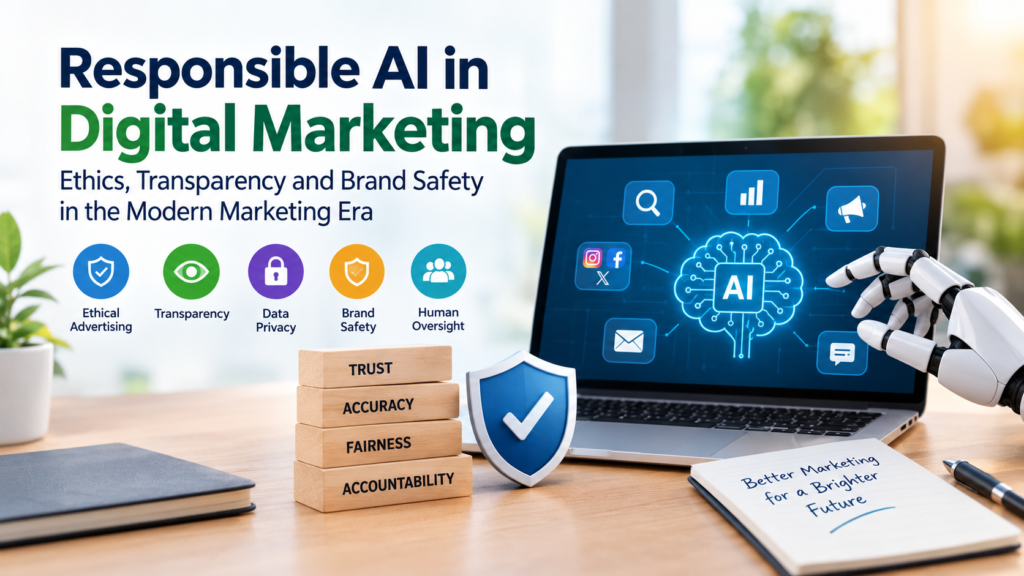
Responsible AI in Digital Marketing: Ethics, Transparency and Brand Safety in the Modern Marketing Era
Introduction: Why Responsible AI Matters in Digital Marketing Artificial intelligence is changing how businesses create content, manage advertising campaigns, analyze customer behaviour, and communicate with audiences. From AI-assisted search engine optimization to automated social media campaigns, marketers now have access to tools that can reduce repetitive work and support faster decision-making. However, using these tools effectively requires more than technical knowledge. Marketers must also understand transparency, data privacy, fairness, and brand safety. People exploring an online digital marketing course can learn about the wider digital marketing skills needed to understand these changes, while DG Mark Institute is one learning resource to explore when considering digital marketing education. Understanding responsible AI is valuable for students, professionals, freelancers, and businesses that want to use automation without compromising customer trust. The growing use of AI creates an important question: how can marketers benefit from technology while remaining honest, accountable, and respectful of their audiences? The answer is not to avoid AI completely or allow it to make every decision. Instead, marketers need a balanced approach that combines automation with human judgment. AI can help identify patterns, generate ideas, and organize information, but people remain responsible for checking the accuracy, fairness, and suitability of the final output. This article explores responsible AI in digital marketing, explains the ethical challenges businesses should understand, and presents practical ways to protect customer trust and brand reputation. 1. Understanding Responsible AI in Digital Marketing Responsible AI refers to the thoughtful development and use of artificial intelligence in ways that consider accuracy, fairness, privacy, transparency, security, and accountability. In digital marketing, this means using AI tools to support business objectives without misleading customers, misusing personal information, spreading false claims, or creating unfair advertising experiences. AI can contribute to several marketing activities, including: These applications can save time, but they also introduce risks. An AI-generated article might contain incorrect information. An advertising system might deliver ads unevenly across audience groups. A chatbot might promise something a company does not offer. Responsible AI practices help marketing teams identify and reduce these risks before they affect customers. AI is a tool, not a replacement for accountability One of the most common misunderstandings about AI is that automated output can be trusted simply because it appears confident or professional. AI systems can produce convincing statements that are incomplete, outdated, or inaccurate. They may also reflect biases present in their training data or the information provided to them. For example, a marketer might ask an AI writing assistant to prepare a blog about the benefits of an online marketing service. The tool could produce a polished article containing unsupported claims about guaranteed business growth. The writing may sound credible, but that does not make the claims true. A responsible marketer checks the information, removes unsupported promises, and ensures the content accurately represents the service. The principle is straightforward: automation can assist with execution, but responsibility for published marketing remains with the people and organizations involved. 2. Why Ethics Has Become Important in Modern Marketing Digital marketing depends heavily on customer attention and trust. Businesses use websites, search engines, social media, email, and paid advertising to build relationships with potential customers. When customers believe that marketing messages are honest and relevant, they are more likely to engage with a brand. Misleading communication, invasive targeting, or fabricated content can damage that relationship. AI makes these concerns more significant because it allows marketers to produce and distribute content at greater speed and scale. A single person can use AI to generate dozens of advertisements, hundreds of social media ideas, or multiple article drafts in a short period. Without suitable checks, mistakes can spread across several channels before anyone notices them. Ethical AI practices help businesses address four important concerns. Accuracy: Marketing messages should be based on reliable information rather than unsupported AI-generated statements. Fairness: Automated systems should be monitored for discriminatory outcomes and inappropriate audience exclusions. Transparency: Customers should not be deliberately misled about a product, service, recommendation, or synthetic representation. Accountability: Businesses should establish who reviews AI output, approves campaigns, and responds when something goes wrong. These principles are relevant to companies of every size. A small business using an AI chatbot faces different operational challenges from a large advertising agency, but both need to consider the consequences of automated communication. Ethical marketing is not simply about avoiding public criticism. It is about developing practices that respect customers while supporting sustainable business growth. 3. How AI Is Transforming Different Areas of Digital Marketing To use AI responsibly, marketers need to understand where it fits into their daily work. AI in search engine optimization AI tools can assist with keyword research, topic clustering, content planning, search-intent analysis, and identifying opportunities to improve existing pages. For example, an SEO professional could use an AI assistant to organize keywords related to digital marketing education into categories such as beginner training, career development, advertising skills, and search engine optimization. The resulting structure can help the professional develop a more organized content plan. However, AI-generated keyword suggestions should not automatically be treated as verified search-volume data. Marketers should use appropriate research tools to check demand and evaluate whether a topic matches the audience’s needs. AI-generated articles also require editorial review. Content should provide useful information, answer real questions, and demonstrate appropriate knowledge of the subject. Publishing large amounts of repetitive material simply because it is easy to generate can produce poor results for readers. Search optimization should focus on relevance, usefulness, originality, and accuracy rather than volume alone. AI in content marketing AI can help writers brainstorm headlines, create outlines, summarize research, and explore different ways of explaining a complex topic. A content team might use AI to prepare an initial outline for an article about responsible advertising. An experienced writer can then add examples, verify claims, improve the structure, and ensure the article reflects the publication’s editorial standards. This approach uses AI to support the writing process rather than treating its first draft as a finished product. Content creators