Digital Omkar Bhujbale

Uncategorized

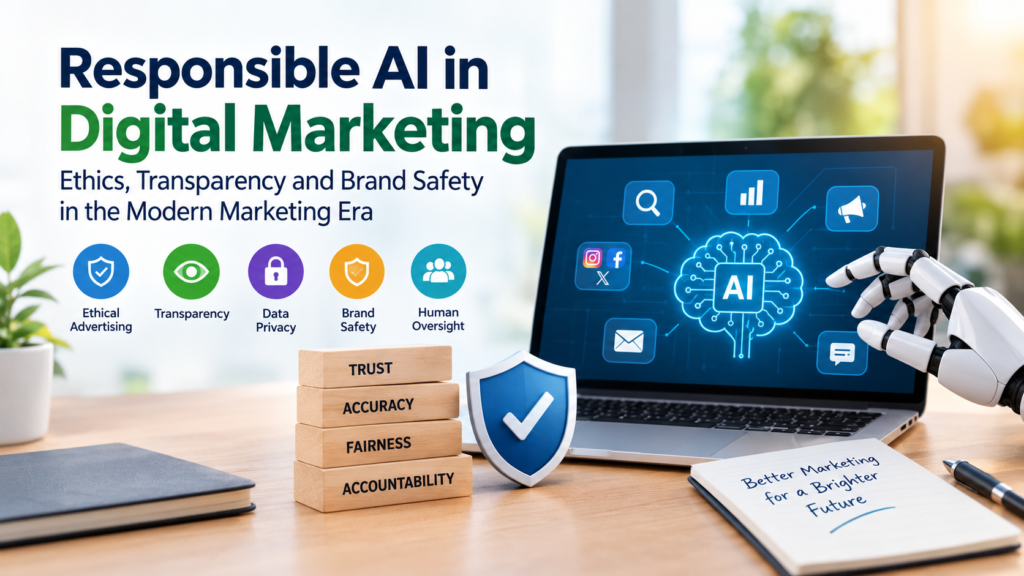
Responsible AI in Digital Marketing: Ethics, Transparency and Brand Safety in the Modern Marketing Era

Introduction: Why Responsible AI Matters in Digital Marketing Artificial intelligence is changing how businesses create content, manage advertising campaigns, analyze customer behaviour, and communicate with audiences. From AI-assisted search engine optimization to automated social media campaigns, marketers now have access to tools that can reduce repetitive work and support faster decision-making. However, using these tools effectively requires more than technical knowledge. Marketers must also understand transparency, data privacy, fairness, and brand safety. People exploring an online digital marketing course can learn about the wider digital marketing skills needed to understand these changes, while DG Mark Institute is one learning resource to explore when considering digital marketing education. Understanding responsible AI is valuable for students, professionals, freelancers, and businesses that want to use automation without compromising customer trust. The growing use of AI creates an important question: how can marketers benefit from technology while remaining honest, accountable, and respectful of their audiences? The answer is not to avoid AI completely or allow it to make every decision. Instead, marketers need a balanced approach that combines automation with human judgment. AI can help identify patterns, generate ideas, and organize information, but people remain responsible for checking the accuracy, fairness, and suitability of the final output. This article explores responsible AI in digital marketing, explains the ethical challenges businesses should understand, and presents practical ways to protect customer trust and brand reputation. 1. Understanding Responsible AI in Digital Marketing Responsible AI refers to the thoughtful development and use of artificial intelligence in ways that consider accuracy, fairness, privacy, transparency, security, and accountability. In digital marketing, this means using AI tools to support business objectives without misleading customers, misusing personal information, spreading false claims, or creating unfair advertising experiences. AI can contribute to several marketing activities, including: These applications can save time, but they also introduce risks. An AI-generated article might contain incorrect information. An advertising system might deliver ads unevenly across audience groups. A chatbot might promise something a company does not offer. Responsible AI practices help marketing teams identify and reduce these risks before they affect customers. AI is a tool, not a replacement for accountability One of the most common misunderstandings about AI is that automated output can be trusted simply because it appears confident or professional. AI systems can produce convincing statements that are incomplete, outdated, or inaccurate. They may also reflect biases present in their training data or the information provided to them. For example, a marketer might ask an AI writing assistant to prepare a blog about the benefits of an online marketing service. The tool could produce a polished article containing unsupported claims about guaranteed business growth. The writing may sound credible, but that does not make the claims true. A responsible marketer checks the information, removes unsupported promises, and ensures the content accurately represents the service. The principle is straightforward: automation can assist with execution, but responsibility for published marketing remains with the people and organizations involved. 2. Why Ethics Has Become Important in Modern Marketing Digital marketing depends heavily on customer attention and trust. Businesses use websites, search engines, social media, email, and paid advertising to build relationships with potential customers. When customers believe that marketing messages are honest and relevant, they are more likely to engage with a brand. Misleading communication, invasive targeting, or fabricated content can damage that relationship. AI makes these concerns more significant because it allows marketers to produce and distribute content at greater speed and scale. A single person can use AI to generate dozens of advertisements, hundreds of social media ideas, or multiple article drafts in a short period. Without suitable checks, mistakes can spread across several channels before anyone notices them. Ethical AI practices help businesses address four important concerns. Accuracy: Marketing messages should be based on reliable information rather than unsupported AI-generated statements. Fairness: Automated systems should be monitored for discriminatory outcomes and inappropriate audience exclusions. Transparency: Customers should not be deliberately misled about a product, service, recommendation, or synthetic representation. Accountability: Businesses should establish who reviews AI output, approves campaigns, and responds when something goes wrong. These principles are relevant to companies of every size. A small business using an AI chatbot faces different operational challenges from a large advertising agency, but both need to consider the consequences of automated communication. Ethical marketing is not simply about avoiding public criticism. It is about developing practices that respect customers while supporting sustainable business growth. 3. How AI Is Transforming Different Areas of Digital Marketing To use AI responsibly, marketers need to understand where it fits into their daily work. AI in search engine optimization AI tools can assist with keyword research, topic clustering, content planning, search-intent analysis, and identifying opportunities to improve existing pages. For example, an SEO professional could use an AI assistant to organize keywords related to digital marketing education into categories such as beginner training, career development, advertising skills, and search engine optimization. The resulting structure can help the professional develop a more organized content plan. However, AI-generated keyword suggestions should not automatically be treated as verified search-volume data. Marketers should use appropriate research tools to check demand and evaluate whether a topic matches the audience’s needs. AI-generated articles also require editorial review. Content should provide useful information, answer real questions, and demonstrate appropriate knowledge of the subject. Publishing large amounts of repetitive material simply because it is easy to generate can produce poor results for readers. Search optimization should focus on relevance, usefulness, originality, and accuracy rather than volume alone. AI in content marketing AI can help writers brainstorm headlines, create outlines, summarize research, and explore different ways of explaining a complex topic. A content team might use AI to prepare an initial outline for an article about responsible advertising. An experienced writer can then add examples, verify claims, improve the structure, and ensure the article reflects the publication’s editorial standards. This approach uses AI to support the writing process rather than treating its first draft as a finished product. Content creators

Responsible AI in Digital Marketing: Ethics, Transparency and Brand Safety in the Modern Marketing Era Read More »

Online Digital Marketing Course for Beginners — 10 Questions to Ask Before You Pay

Online Digital Marketing Course for Beginners — 10 Questions to Ask Before You Pay Third-party SEO blog | DG Mark Institute | Beginner’s buying guide This version is written from an independent blogger’s perspective, with both DG Mark Institute backlinks in the opening paragraph. It focuses on helping readers make an informed decision before enrolling in an online digital marketing course. Choosing an online digital marketing course is an important decision for anyone planning to learn new skills, explore a career change, or promote a business more effectively. Before paying for training, beginners should compare the syllabus, practical experience, teaching approach, fees, and learner support. Exploring DG Mark Institute and its online digital marketing course can be one part of that research, alongside reviewing other learning options and deciding which programme best matches individual goals. Introduction: Don’t Pay for a Course Before Asking the Right Questions Imagine you have decided to learn digital marketing. You start searching online and find dozens of courses promising practical skills, certificates, career opportunities, and expert guidance. Some advertisements focus on affordable fees, while others highlight advanced tools, live projects, or job assistance. Every programme appears attractive, and choosing one becomes confusing. This situation is common among beginners. When you have little experience in digital marketing, it can be difficult to distinguish a well-structured learning programme from a course that simply offers recorded lessons and a certificate. You might not know which topics matter, what practical training should include, or how much support you should expect after enrolling. The biggest mistake is making a payment based only on an advertisement, a discount, or a promise of quick career growth. A course that looks affordable may require additional spending on tools or software. Another programme might have an impressive syllabus but provide limited opportunities to practise. Even a recognised certificate cannot replace the ability to demonstrate your skills to a potential employer or client. The solution is straightforward: ask questions before you pay. A little research can help you understand what you will learn, how you will practise, who will teach you, and whether the programme fits your schedule and budget. It also gives you an opportunity to set realistic expectations about what a course can achieve. Digital marketing includes several areas, such as search engine optimisation (SEO), social media marketing, paid advertising, content creation, email marketing, website development, and analytics. Beginners do not necessarily need to master every specialisation immediately. They need a structured starting point and opportunities to build their knowledge gradually. This guide explains ten important questions to ask before enrolling in an online digital marketing course. It also explains how to evaluate DG Mark Institute as one possible option without relying on promotional claims alone. Why Beginners Should Research a Course Before Paying Learning digital marketing can be useful for people with different objectives. A student might want to prepare for an entry-level role. A working professional may want to develop new skills. A freelancer might want to offer SEO or social media services, while a small business owner could be interested in generating leads online. Although these learners have different goals, they share one important requirement: they need training that matches their needs. Before selecting a programme, consider three things. First, identify your objective. Are you learning for employment, freelancing, career development, or your own business? Your answer will influence which subjects deserve the most attention. Second, evaluate the learning experience. Check whether the course includes explanations, assignments, practical exercises, feedback, and opportunities to ask questions. Learning a concept is only the first step; applying it is equally important. Third, understand the complete commitment. Consider the fees, course duration, class timings, equipment requirements, study hours, and terms of enrolment. A course should be judged by the value it provides and how well it supports your goals, not simply by its popularity or advertising. Question 1: What Exactly Will I Learn in the Course? The first question should always be about the curriculum. Before paying, request a detailed syllabus and check whether the subjects align with your goals. Digital marketing is a broad field. A course may introduce you to several areas, but the depth of training can vary significantly. One programme might concentrate on social media content, while another may include search engine optimisation, website development, paid advertising, analytics, and email marketing. Understand the core subjects A useful beginner-level curriculum should explain the purpose of the main digital marketing channels and how they work together. The right curriculum depends on the type of course and your intended career path. You do not need advanced knowledge of every channel at the beginning, but you should understand the fundamentals and know which skills the programme develops in depth. Ask about practical application A syllabus can list many impressive topics without explaining how you will use them. Ask the provider to show you a sample lesson, module breakdown, or assignment. For example, if a course includes SEO, will you practise keyword research and page optimisation? If it teaches advertising, will you learn how campaign objectives, budgets, targeting, and conversion tracking work? If it covers social media, will you create a content calendar and evaluate results? These questions reveal more about the learning experience than a long list of module names. What to check before paying: Request the syllabus, identify the subjects most relevant to your goals, and ask how each major topic is taught and assessed. Question 2: Is the Course Suitable for a Complete Beginner? Not everyone entering digital marketing has a background in advertising, business, technology, or communication. A good beginner learning experience should explain foundational concepts before introducing more complicated strategies. You should not feel that you need to understand SEO terminology, advertising dashboards, website development, or analytics before your first lesson. Look for a logical learning sequence A beginner-friendly programme should ideally start with questions such as: Once these fundamentals are clear, the course can introduce more specific topics and tools. For example, a learner should understand the difference

Online Digital Marketing Course for Beginners — 10 Questions to Ask Before You Pay Read More »

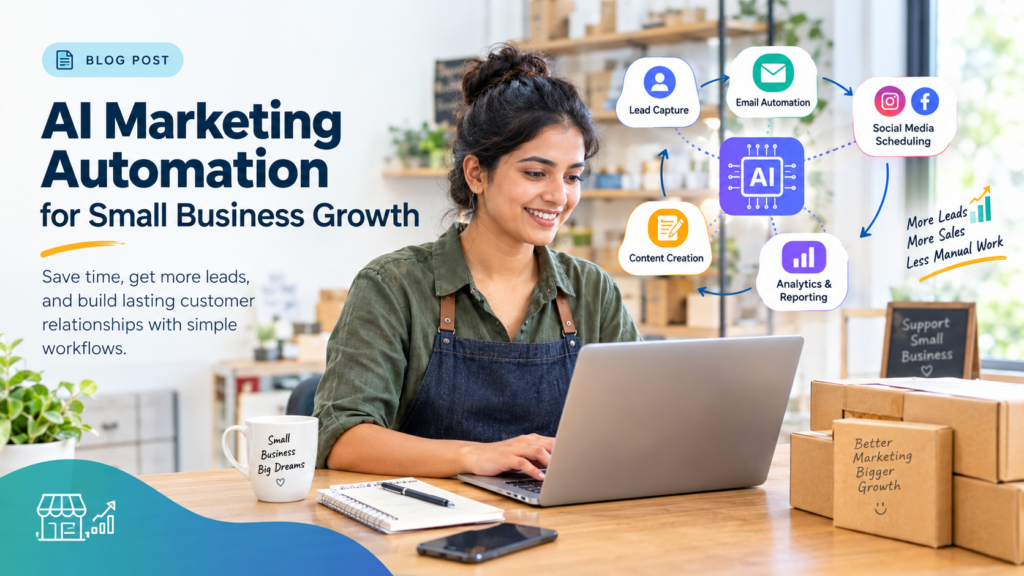
AI Marketing Automation for Digital Marketing: A Beginner’s Guide to Simple Workflows

AI Marketing Automation for Digital Marketing: A Beginner’s Guide to Simple Workflows As digital marketing becomes more data-driven, businesses and aspiring marketers are learning how to combine creativity with automation to work more efficiently. Understanding these technologies alongside core marketing principles is an important step for anyone exploring an online digital marketing course or developing practical marketing skills. AI marketing automation helps simplify repetitive tasks such as lead follow-ups, email campaigns, content planning, and performance reporting, allowing marketers to spend more time understanding customers and improving their strategies. This beginner-friendly guide explains what AI marketing automation is, how simple workflows operate, which tools can help, and how students, freelancers, small businesses, and marketing teams can start using automation responsibly. 1. What Is AI Marketing Automation? AI marketing automation is the use of software, predefined rules, and artificial intelligence to help businesses manage marketing activities with less manual effort. It combines traditional automation with AI capabilities such as text generation, data analysis, classification, recommendations, and conversational responses. Imagine a small business receiving 50 inquiries in a day. A marketer might have to read every message, record contact details, identify the customer’s requirements, send a reply, and schedule a follow-up. These tasks take time, particularly when the same process repeats every day. An automated workflow can record the inquiry, send an acknowledgment, update a customer relationship management (CRM) system, and notify the sales team. An AI component might help summarize the customer’s question or categorize the inquiry by intent. A person can then review the information and handle more complex conversations. The important point is that AI and automation perform different but complementary roles. Traditional automation versus AI-powered automation Traditional automation AI-assisted automation Follows predefined rules Can interpret patterns or unstructured information Sends a message when a specified condition is met Can help personalize or draft a message Moves information between connected applications Can summarize or categorize information before passing it along Produces scheduled reports Can help identify unusual trends in the reported data Requires rules for predictable decisions Can assist with decisions that involve language or patterns, subject to review For example, a traditional workflow might send a welcome email whenever someone subscribes to a newsletter. An AI-assisted workflow could also help create a relevant email draft based on the subscriber’s selected interests, provided those interests are collected appropriately and the platform supports the integration. AI does not make every marketing task automatic. Some tasks still require human judgment, approval, or manual action. The four basic elements of an automated workflow Most beginner-friendly workflows can be understood through four elements. 1. Trigger: The event that starts the workflow, such as a form submission, a new subscriber, or a scheduled reporting time. 2. Condition: A rule that determines what happens next. For example, the workflow might check whether a person has requested a course brochure. 3. Action: The task performed by the system, such as sending a confirmation email, updating a record, or notifying a salesperson. 4. Measurement: The process of checking whether the workflow achieves its purpose, such as reducing response time or increasing qualified inquiries. A workflow may also contain AI-generated recommendations, approval steps, delays, branches, and error-handling rules. Platforms differ in their capabilities and subscription requirements. HubSpot’s official documentation, for example, describes workflow creation through triggers and configurable actions, with certain features dependent on the subscription. HubSpot Knowledge Base +1 2. Why AI Marketing Automation Matters in Digital Marketing Digital marketing involves multiple connected activities. A single campaign may require keyword research, content creation, landing page development, advertising, lead collection, follow-up communication, and reporting. When every task is performed manually, delays and inconsistencies can develop. Automation helps standardize repeatable processes, while AI can assist with analysis and content-related work. Saving time on repetitive activities Marketers frequently repeat the same actions: formatting reports, copying lead details, preparing content drafts, scheduling posts, and sending routine updates. These tasks may be necessary, but they do not always require a person to perform every step manually. Consider a freelancer who manages three clients. Each Monday, the freelancer collects campaign data, updates a spreadsheet, prepares a summary, and emails the results. A connected reporting workflow may collect available data and create a draft summary automatically. The freelancer still needs to check the figures, explain changes, and recommend next steps. Automation reduces the administrative burden without removing professional responsibility. Improving the consistency of follow-ups A potential customer may submit a form outside normal business hours. Without a defined process, the inquiry might remain unanswered until the next working day. An automated acknowledgment can confirm that the inquiry was received and explain when the customer can expect a response. The system can also notify the relevant team member. However, an acknowledgment should not be confused with a complete sales conversation. Personalized advice, price negotiations, and complex customer questions often require a human response. Supporting more relevant communication Customers have different needs and levels of interest. A person downloading an introductory guide may need educational information, while someone requesting a product demonstration may be closer to making a purchase. Segmentation allows marketers to organize contacts into groups based on appropriate information, such as their interests, previous interactions, or stated preferences. AI can help categorize incoming text or suggest content variations for these groups. Marketers should still check that the personalization is accurate, respectful, and based on information the business is permitted to use. Making campaign data easier to understand A digital marketer may need to review website traffic, lead form submissions, email engagement, advertising costs, and conversions. Reporting automation can organize the available information into a consistent dashboard or report. AI-assisted analysis may then help identify patterns that deserve attention. Google Analytics documents automated insights that detect unusual changes or emerging trends in data, as well as custom insights based on conditions configured by the user. Analytics Help +1 These insights are useful starting points for investigation, not automatic proof of what caused a change. A decline in traffic, for example, could relate to seasonality, a

AI Marketing Automation for Digital Marketing: A Beginner’s Guide to Simple Workflows Read More »

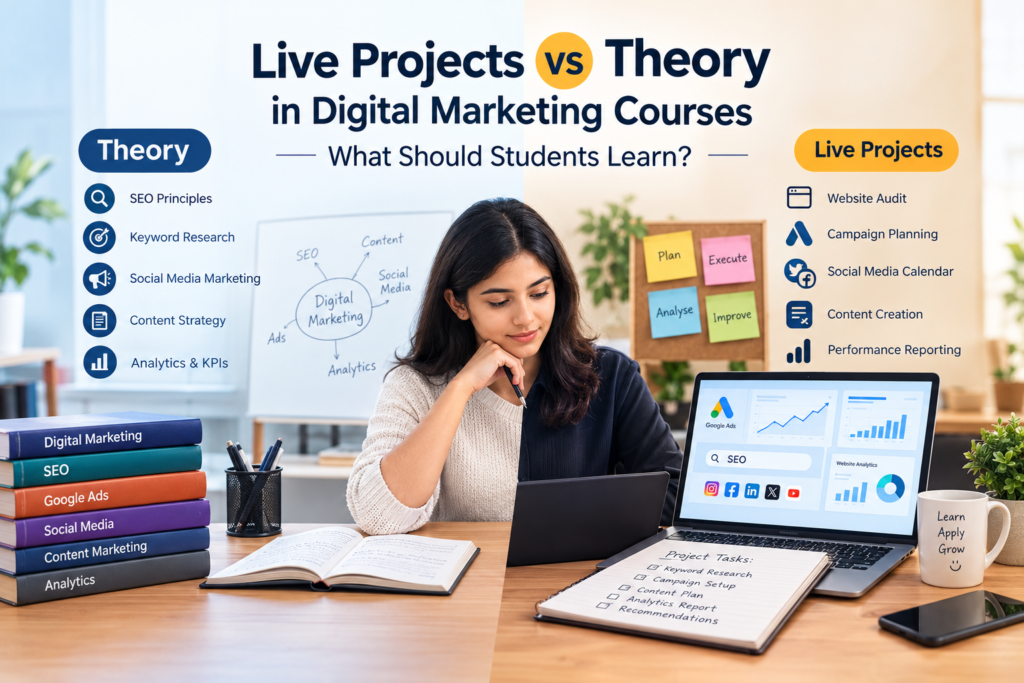
Live Projects vs Theory in Digital Marketing Courses: What Should Students Learn?

Live Projects vs Theory in Digital Marketing Courses: What Should Students Learn? Digital marketing is not just about understanding how search engines work, writing social media captions, or learning the names of advertising tools. It also involves applying that knowledge to business situations, interpreting data, solving problems, and making informed marketing decisions. This is why the discussion around live projects vs theory in digital marketing courses is important for students, fresh graduates, working professionals, and aspiring freelancers. Imagine a student who can explain search engine optimization (SEO), keyword research, and Google Ads in an interview. However, when asked to audit a website, prepare a keyword strategy, structure an advertising campaign, or interpret website analytics, the student struggles to apply those concepts. This gap between knowing something and doing it highlights the importance of practical learning. Theory helps students understand the principles behind digital marketing, while practical projects give them opportunities to apply those principles in realistic situations. Neither approach needs to replace the other. A structured learning experience can combine both to develop a stronger understanding of marketing strategy and execution. But what should learners look for when choosing a digital marketing course? Are live projects essential? Can beginners practise without spending money on advertising? And how can students demonstrate their abilities to potential employers or clients? This guide explores the differences between theory-based learning and live project training, explains how practical assignments work across different digital marketing disciplines, and shares a step-by-step approach to building useful, portfolio-ready skills. Understanding Theory-Based Learning in Digital Marketing Theory-based learning introduces the concepts, principles, frameworks, and terminology that explain how digital marketing works. It gives students the background they need to understand why a particular strategy might be suitable for one business but ineffective for another. For beginners, theory provides a foundation before they start working with marketing tools or making campaign decisions. 1. Learning search engine optimization Search engine optimization involves improving a website’s visibility in unpaid search results. Theoretical learning introduces topics such as search intent, keyword relevance, website structure, content quality, internal linking, and technical SEO. For example, a student might learn that a page should answer the question behind a search query rather than simply repeat a keyword several times. This helps the learner understand why useful, relevant content matters. 2. Understanding paid advertising Paid advertising theory covers campaign objectives, audience targeting, bidding, ad relevance, budgets, and performance measurement. A student may learn the difference between impressions, clicks, conversions, cost per click (CPC), and cost per acquisition (CPA). These concepts help learners understand what advertising reports measure and why different businesses choose different campaign objectives. 3. Studying social media marketing Theory introduces audience research, brand positioning, content pillars, engagement, platform selection, and content planning. For example, a business targeting professionals may need a different communication style and content strategy from a business targeting college students. Understanding the audience helps students make more thoughtful content decisions. 4. Learning content marketing Content marketing focuses on creating and distributing useful information for a defined audience. Students learn how to identify customer questions, organise topics, create content plans, and connect content with different stages of the customer journey. These principles are useful when developing blogs, landing pages, social media posts, email campaigns, and educational resources. 5. Understanding analytics and performance measurement Marketing analytics helps learners understand whether their activities are contributing to business objectives. Students may study metrics such as traffic, engagement, leads, conversions, and campaign costs. They also learn that a metric must be interpreted in context. More website visits, for example, do not automatically mean that a business is generating more qualified leads. 6. Learning responsible marketing practices Digital marketers must also understand privacy, consent, advertising policies, data handling, and ethical communication. These subjects are not separate from practical skills. A campaign may be technically well executed but still create problems if it uses misleading claims, mishandles customer information, or violates platform policies. Why does theory matter? It provides a framework for evaluating decisions rather than relying on guesswork. Without a clear understanding of marketing principles, students may learn to operate tools without knowing when or why to use them. What Is Live Project Training in Digital Marketing? Live project training gives learners opportunities to apply digital marketing concepts to a defined task, business scenario, website, campaign, or dataset. The term “live project” can mean different things across training providers. Some projects involve an actual business website or an authorised client assignment. Others use practice websites, sample analytics data, simulated campaigns, or supervised exercises designed to resemble real working conditions. These formats can all support learning, but they are not identical. Students should ask what a course means by live project training before enrolling. Typical project activities include: Consider a student learning about keyword research. In a theory session, the student may understand search intent and keyword relevance. During a project, the student could research a hypothetical online course provider, group relevant queries by intent, map topics to pages, and recommend improvements to the website’s content. The practical task turns a general concept into a set of decisions and deliverables. What makes a project useful? A good learning project should have a clear objective, a defined audience, appropriate resources, a process to follow, and a way to evaluate the final work. For example, a website audit should not end with a long list of technical terms. It should explain which issues matter, why they may affect users or search visibility, and what the business could do next. Similarly, a campaign plan should connect its proposed audience, budget, creative assets, and measurement approach to a stated business goal. A project becomes more educational when learners receive feedback, identify mistakes, revise their work, and explain the reasoning behind their recommendations. However, not every course provides access to real client accounts, live advertising budgets, or production websites. Students should confirm the available tools, project format, supervision, and deliverables rather than assuming that all practical training offers the same experience. Live Projects vs Theory

Live Projects vs Theory in Digital Marketing Courses: What Should Students Learn? Read More »

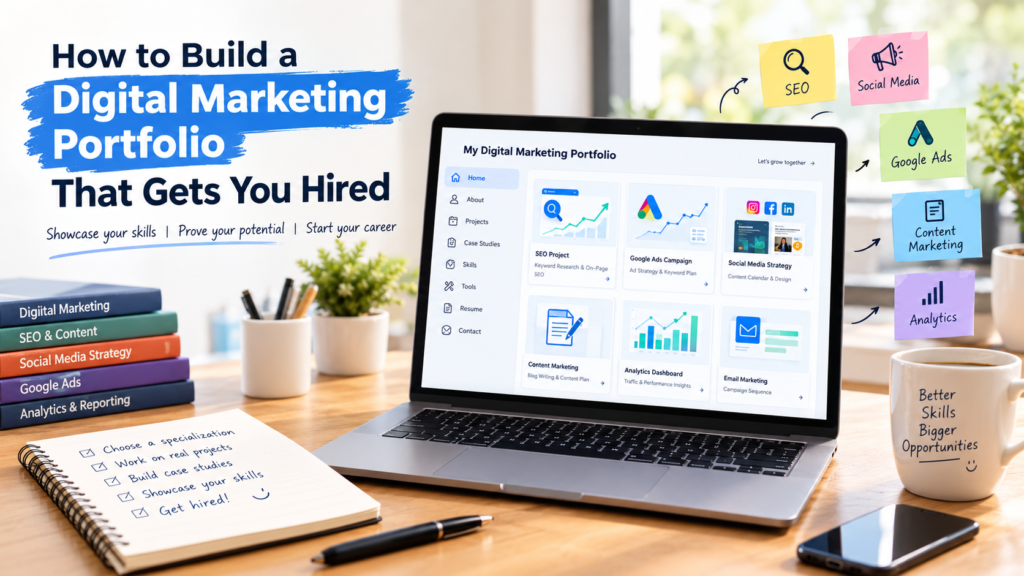
How to Build a Digital Marketing Portfolio That Gets You Hired

How to Build a Digital Marketing Portfolio That Gets You HiredThird-party guest blog for digital marketing students, freshers, career switchers, and aspiring professionals Introduction Imagine applying for your first digital marketing job. You have completed a course, learned about search engine optimization, practised creating social media posts, and explored advertising platforms. You prepare your resume, mention your skills, and submit your application. However, when a recruiter asks, “Can you show me what you have done?”, you are unsure what to share. This is a common challenge for students, freshers, and career changers entering digital marketing. Learning the concepts is important, but employers also want to understand how candidates apply their knowledge to practical situations. That is where a digital marketing portfolio becomes valuable. A portfolio gives you a place to showcase your work, explain your decisions, demonstrate your research, and communicate how you would approach marketing challenges. It can contain SEO audits, content plans, sample advertising campaigns, social media calendars, landing page recommendations, email marketing sequences, and analytics reports. The good news is that you do not need years of professional experience to create one. You can start with practice projects, fictional business scenarios, your own website, or projects completed with permission for a real business. The key is to describe your work honestly and explain what it demonstrates. Learning how to build a digital marketing portfolio is not simply about designing an attractive website. It is about creating evidence of your abilities and presenting that evidence in a way that is relevant to employers. In this guide, you will learn how to choose your specialization, develop practical projects, write compelling case studies, select the right tools, organize your portfolio, and use it effectively when applying for jobs.What Is a Digital Marketing Portfolio?A digital marketing portfolio is a collection of work samples that demonstrates your marketing knowledge, practical skills, creative thinking, and ability to solve business problems. It can be a personal website, a collection of case studies, a presentation, a PDF document, or an organized online folder. Its purpose is to help recruiters, hiring managers, and potential clients understand what you can do beyond the information listed on your resume. For example, a resume might say that you know SEO, keyword research, and content optimization. Your portfolio can show a keyword research spreadsheet, a sample content strategy, an on-page SEO audit, and an explanation of why you recommended particular changes. That difference matters because employers can review your approach rather than relying entirely on a list of skills.What is the difference between a resume and a portfolio?A resume summarizes your education, experience, skills, and qualifications. A portfolio demonstrates how you apply those skills.Resume Digital marketing portfolioSummarizes qualifications Demonstrates practical workLists skills and experience Shows examples of those skillsUsually follows a concise format Can include detailed case studiesHighlights responsibilities and achievements Explains objectives, research, decisions, and outcomesHelps introduce you to employers Gives employers evidence to evaluate The two work best together. Your resume should make a recruiter interested in your application, while your portfolio should help them understand the quality of your work.What should a digital marketing portfolio include?A strong beginner portfolio can include: Similarly, knowing about social media marketing is not the same as developing a monthly content calendar with audience personas, content pillars, formats, and performance indicators. Your portfolio connects theory with application. For example, imagine a fictional local bakery wants to improve its online visibility. You could create a sample project covering local keyword research, Google Business Profile recommendations, website content improvements, and social media content ideas. Even without actual campaign results, the project can demonstrate how you think through a marketing challenge. You can explain why you selected a particular audience, how you prioritized keywords, what challenges you encountered, and what you would measure after implementation. This makes it easier to discuss your reasoning and acknowledge what you still need to learn. A social media calendar, sample landing page audit, or SEO content strategy can help a prospective client understand the work involved in a project. Make sure sample work is clearly identified as sample work. Never imply that a fictional project represents a paying client. A portfolio cannot guarantee an interview or a job. However, when combined with relevant skills, a clear resume, good communication, and suitable applications, it can give employers more information to assess your potential.Step 1: Choose Your Digital Marketing SpecializationBefore building projects, decide which digital marketing skills you want to demonstrate. You can explore several areas, but your portfolio should have a clear direction. Review job descriptions for entry-level positions and note the skills employers repeatedly request. Then select projects that demonstrate those skills.Search Engine Optimization (SEO)SEO focuses on improving a website’s visibility in organic search results. An SEO portfolio can demonstrate your ability to research keywords, understand search intent, improve website content, and identify technical or on-page issues. Suitable projects include: Your portfolio could include a 30-day content calendar, sample Instagram posts, short-form video concepts, audience personas, and a social media performance report. Explain why you selected particular formats and topics. For instance, a local restaurant may benefit from menu highlights, customer education, behind-the-scenes content, and location-specific posts. A content calendar should demonstrate more than creativity. It should connect each post to an objective, such as awareness, engagement, website visits, or enquiries.Google Ads and PPC AdvertisingPaid advertising requires a clear understanding of audience targeting, keyword selection, ad copy, budgets, conversion tracking, and performance measurement. Create a mock campaign for a fictional business. Include the campaign objective, keyword themes, sample ads, landing page recommendations, proposed budget, and measurement plan. Clearly label the project as a campaign proposal if you have not launched it. Do not present estimated clicks, conversions, or return on ad spend as actual campaign results.Content Marketing and BloggingContent marketing involves creating useful material that attracts, educates, and supports an audience. Suitable portfolio projects include SEO blog articles, content briefs, topic clusters, editorial calendars, downloadable guides, and content refresh recommendations. Show how you selected a topic, identified the

How to Build a Digital Marketing Portfolio That Gets You Hired Read More »

What is digital marketing

What Is Digital Marketing? A Complete Guide for Beginners Digital marketing has become one of the most important parts of modern business. Whenever someone searches for a product on Google, watches a brand video on YouTube, sees an Instagram advertisement, receives a promotional email, or visits a business website, they may be interacting with digital marketing. In simple terms, digital marketing is the promotion of products, services, brands, or businesses through digital channels and technologies. These channels include search engines, websites, social media, email, online advertising, mobile platforms, and other digital media. Unlike traditional marketing, digital marketing allows businesses to reach specific audiences, measure campaign performance, collect useful data, and make changes based on results. It combines creativity, communication, technology, and data analysis. For students, digital marketing can also be an interesting career field because it covers many different skills, from SEO and social media to Google Ads, content marketing and analytics. Institutes such as DGmark Institute can be one option for people who prefer structured, practical learning. This guide explains what digital marketing means, how it works, its major types, benefits, tools, career opportunities, and how beginners can start learning it. What Is Digital Marketing? Digital marketing refers to marketing activities performed using digital channels and technologies to connect businesses with potential and existing customers. A simple definition is: Digital marketing is the process of promoting a product, service, brand, or business through digital channels to reach, engage, and convert a target audience. These channels can include: Cambridge Dictionary similarly describes digital marketing as marketing products or services through digital methods such as social media, email, search engines and websites. For example, imagine a new restaurant opens in Mumbai. Instead of relying only on banners or newspaper advertisements, the restaurant could create an Instagram page, register its business on Google, publish its menu online, run Google Ads, create Reels, collect customer reviews and send offers to existing customers. All these activities can form part of a digital marketing strategy. The important thing to understand is that digital marketing is not simply posting on Instagram. It is a broad field involving multiple channels and strategies that work together to achieve business objectives. ⸻ How Does Digital Marketing Work? Digital marketing usually starts with a business objective. The objective could be: Once the objective is clear, marketers identify the target audience and choose appropriate digital channels. A basic digital marketing process can look like this: Goal → Audience Research → Strategy → Content/Advertising → Traffic → Conversion → Measurement → Optimization For example, suppose a digital marketing institute wants more students to enquire about its courses. It could: This continuous process is important because digital marketing is not normally a one-time activity. Google describes it as a cycle involving planning, audience definition, content and channel activation, performance analysis, and continuous optimization. ⸻ Traditional Marketing vs Digital Marketing Traditional marketing includes channels such as newspapers, magazines, television, radio, billboards and printed brochures. Digital marketing uses digital platforms such as Google, websites, social media, email and online advertising. Factor Traditional Marketing Digital MarketingMedium TV, newspaper, radio, print Search, websites, social media, emailTargeting Usually broader Can be highly specificMeasurement Sometimes difficult Detailed measurement availableInteraction Mostly one-way Highly interactiveOptimization Often slower Can be adjusted quicklyGeographic reach Often location-focused Can reach local or global audiencesBudget flexibility Varies Campaigns can often be scaledData Limited compared with digital Extensive campaign data This does not mean traditional marketing has become useless. Businesses can use both traditional and digital channels depending on their audience, industry and objectives. For example, a local store could use outdoor advertising for visibility while also using Google Business Profile, Instagram and WhatsApp to communicate with customers. ⸻ Major Types of Digital Marketing Digital marketing contains several different specializations. Businesses do not necessarily need to use every channel. The right combination depends on the target audience and business goals. Search Engine Optimization, commonly called SEO, is the process of improving a website and its content to increase its visibility in organic search results. Suppose someone searches Google for: “Best digital marketing institute in Borivali” If a relevant website appears in the unpaid search results, SEO may have contributed to that visibility. SEO generally includes: SEO is generally a long-term strategy. Unlike paid advertising, businesses don’t directly pay a search engine for every organic click. However, ranking organically requires useful content, technical optimization, authority and consistent effort. ⸻ Paid search advertising allows businesses to display advertisements when users search for relevant terms. Google Ads is one of the best-known platforms used for search advertising. For example, someone searches: “digital marketing course Mumbai” A business can potentially show an advertisement for its course when that search occurs. Important concepts include: Google describes search engine marketing as advertising that can show alongside search results based on keywords users search for. PPC campaigns can provide faster visibility than SEO, but they require proper targeting, budget management and optimization. ⸻ Social media marketing involves using social platforms to build awareness, communicate with audiences, promote products and generate business results. Popular platforms include: Social media marketing can be divided broadly into: Organic marketing:Regular posts, Reels, videos, stories, community engagement and other unpaid activities. Paid marketing:Advertisements created through platforms such as Meta Ads. A clothing brand, for example, might post styling videos on Instagram, collaborate with creators and run advertisements targeting people interested in fashion. Social media is particularly useful for brands that depend on visual content and community engagement. ⸻ Content marketing focuses on creating and distributing useful content for a specific audience. Examples include: The purpose isn’t always to make an immediate sale. A business might first educate a potential customer, build trust and establish expertise. That person may then become a lead or customer later. For example, a fitness company could publish articles about workout routines and nutrition. Someone searching for that information may discover the company through Google and eventually explore its products or services. Good content marketing focuses on helping the audience, rather than simply promoting a

What is digital marketing Read More »

DG MARK INSTITUTE

DGmark Institute: Complete Guide to Digital Marketing Courses, Training, Career & Learning Experience Digital marketing has become an important skill for students, fresh graduates, working professionals, business owners and freelancers. As businesses increasingly depend on websites, search engines, social media and online advertising, the demand for people who understand digital marketing continues to grow. For someone living in Mumbai, choosing the right digital marketing institute can be confusing. There are many institutes offering courses with different durations, fees, syllabuses and learning methods. Some focus mainly on theory, while others emphasize practical assignments, advertising platforms, SEO, social media and website development. One name that students researching digital marketing education in Mumbai may come across is DGmark Institute. DGmark Institute is associated with DGmark Agency, a Mumbai-based digital marketing agency. According to DGmark Agency’s official website, the institute was founded in 2020 as part of its effort to develop digital marketing professionals. The agency itself states that it has been operating since 2016 and provides services including SEO, Google Ads, social media marketing, website development and complete digital marketing. This article takes an independent look at DGmark Institute, its connection with DGmark Agency, the areas students can expect to study, the importance of practical learning, potential career opportunities and the factors students should consider before enrolling in a digital marketing course. ⸻ What Is DGmark Institute? DGmark Institute Borivali is a digital marketing training institute in Mumbai. Current business listings also show DGmark Institute locations in Goregaon and Andheri. The institute is connected with DGmark Agency, a digital marketing company that works across areas such as SEO, Google Ads, social media marketing, paid advertising and website development. This agency connection is particularly relevant because digital marketing is a practical field where understanding how campaigns, websites and advertising platforms work in real situations can be valuable. According to DGmark Agency’s official website, DGmark Institute was founded in 2020. The agency describes the institute as part of its commitment to developing skilled digital marketing professionals. For students, the important question is not simply when an institute was established. The more important questions are: These are the areas that should be evaluated before making a final decision. ⸻ DGmark Institute and DGmark Agency: What Is the Connection? One of the distinctive aspects of DGmark Institute is its association with DGmark Agency. DGmark Agency describes itself as a digital marketing agency based in Mumbai that provides services including website development, SEO, Google Ads, social media marketing, paid advertising and complete digital marketing solutions. The agency’s website states that it was founded in 2016 and that DGmark Institute was founded in 2020. This connection can be relevant from a learning perspective because students entering digital marketing often benefit from understanding how different skills are connected. For example, a digital marketing campaign might involve: Website → SEO → Google Ads → Social Media → Content → Analytics → Leads Instead of learning these subjects as completely separate topics, students can understand how they work together as part of a marketing strategy. That broader understanding can be useful for students who eventually want to work in agencies, companies or freelancing. ⸻ Why Digital Marketing Training Is Important Digital marketing is much broader than simply creating Instagram posts. A professional digital marketer may need to understand: This is why choosing a course based only on the course title can be misleading. A good digital marketing learning program should ideally combine concepts + tools + assignments + practical application. For example, learning what Google Ads is theoretically is different from actually creating a campaign structure, selecting keywords, writing advertisements, understanding bidding strategies and measuring conversions. The same applies to SEO. Understanding the definition of SEO is easy. Learning how to conduct keyword research, optimize pages, analyze competitors, improve technical issues and monitor rankings requires practice. ⸻ What Can Students Learn at DGmark Institute? The exact curriculum and course structure can change over time, so prospective students should confirm the latest syllabus directly with the institute. However, the broader digital marketing ecosystem associated with DGmark Agency covers several major areas, including SEO, Google Ads, social media marketing, website development and complete digital marketing. A comprehensive digital marketing learning path generally includes the following areas. ⸻ SEO is one of the most important parts of digital marketing. It focuses on improving a website’s visibility in organic search results. Students learning SEO generally need to understand: DGmark Agency itself lists SEO as one of its major services and describes activities such as keyword research, website optimization, content optimization and link-building strategies. This agency-side experience makes SEO particularly relevant for learners who want to understand how SEO is applied beyond textbooks. ⸻ Google Ads is another important skill for digital marketers. Unlike SEO, which focuses primarily on organic visibility, Google Ads allows businesses to pay for advertising opportunities across Google’s advertising ecosystem. Students can learn concepts such as: DGmark Agency identifies Google Ads as one of its core services and says its team manages targeted paid advertising campaigns with a focus on performance and conversions. For students interested in performance marketing, understanding Google Ads can be particularly valuable. ⸻ Social media has become an important communication channel for businesses. A digital marketing course can introduce students to: DGmark Agency’s service offering includes social media marketing and describes activities such as strategy development, content creation and community engagement. Students can use these skills for agency jobs, social media roles, freelance work or their own projects. ⸻ Meta Ads are particularly relevant for businesses that want to reach audiences on platforms such as Facebook and Instagram. Students can learn concepts including: Understanding paid social advertising can help students move beyond simply creating organic posts. They can learn how advertisements are structured, targeted and evaluated. ⸻ A website is often the foundation of a digital marketing strategy. Search traffic, social media campaigns and paid advertisements frequently direct users to a website or landing page. DGmark Agency lists website development among its core services and describes its approach

DG MARK INSTITUTE Read More »

DGmark Agency: TheFuture-Ready Digital Marketing Agency Helping Businesses Scale Smarter

DGmark Agency: The Future-Ready Digital Marketing Agency Helping Businesses Scale Smarter By Digital Omkar Bhujbale (Independent Digital Marketing Blogger) Introduction: Why “Future-Ready” Digital Marketing Matters Today In today’s hyper-digital economy, businesses are no longer competing just on products or pricing—they are competing on visibility, positioning, and data-driven decision-making. Whether you’re a startup founder, SME owner, or enterprise leader, one truth is unavoidable: your growth depends on how effectively you leverage digital marketing. But here’s the challenge—most businesses either: This is where agencies like DGmark Agency enter the picture. Based in Mumbai, this agency has been gaining traction for its ROI-focused, AI-powered, and performance-driven approach to digital marketing. As an independent digital marketing blogger, I’ve analyzed multiple agencies across India, and in this article, I’ll break down: 👉 Official website reference: https://dgmarkagency.com The Rise of Performance-Driven Digital Marketing Agencies Before diving into DGmark Agency specifically, it’s important to understand the broader shift happening in digital marketing. From Vanity Metrics to Business Outcomes Earlier, success was measured through: Today, the focus has shifted to: Modern businesses demand measurable growth, not just activity. The Shift Toward AI & Automation Digital marketing is no longer manual-heavy. Agencies now leverage: DGmark Agency positions itself within this transformation by offering AI-powered marketing frameworks and data-backed strategies. (DGmark Agency) About DGmark Agency: A Quick Overview DGmark Agency is a Mumbai-based digital marketing firm that provides a full suite of services, including: Founded by digital marketer Chandan Thakur, the agency has positioned itself as a growth partner for SMEs and startups. Key Highlights: The agency emphasizes “scaling smarter, not just faster”, which aligns with modern marketing philosophy. Core Services That Drive Business Growth 1. Search Engine Optimization (SEO) SEO remains the backbone of sustainable digital growth. DGmark Agency focuses on: Their approach is results-oriented rather than purely theoretical, with an emphasis on ranking and lead generation. 👉 According to their platform, SEO campaigns are designed to improve visibility, traffic, and conversions simultaneously. (DGmark Agency) 2. Performance Marketing (Google Ads & Paid Campaigns) Paid advertising is where many businesses waste money due to poor targeting. DGmark Agency claims to optimize: Their goal is clear:Lower ad spend wastage + higher conversion rates 3. Social Media Marketing Social media today is not just about posting content—it’s about building brand authority and driving engagement. Their services include: 4. Website Development & Conversion Optimization A major differentiator is their integration of: Because ultimately, traffic without conversion is useless. 5. Complete Digital Marketing Packages DGmark Agency also offers end-to-end digital marketing solutions, combining: This integrated approach ensures consistency across channels. (Digital Marketing Community) What Makes DGmark Agency “Future-Ready”? Let’s move beyond services and analyze their positioning. 1. AI-Powered Marketing Framework One of the standout aspects is their use of AI in: This allows:✔ Faster decision-making✔ Better targeting✔ Improved ROI As mentioned on their official platform, AI helps reduce ad waste and improve campaign efficiency. (DGmark Agency) 2. Data Transparency & Reporting A common complaint with agencies is lack of transparency. DGmark Agency addresses this by offering: This builds client trust and accountability. 3. Local Expertise + Global Strategy Being based in Mumbai gives them: At the same time, they apply global marketing frameworks, creating a hybrid approach. 4. Focus on ROI, Not Just Activity Unlike many agencies that focus on deliverables (posts, clicks, impressions), DGmark emphasizes: This shift is critical in modern marketing. 5. Integration with Skill Development Ecosystem Interestingly, DGmark is also associated with a training initiative called DGmark Institute, which focuses on building digital marketing professionals. This creates: Real-World Impact: How Businesses Benefit From available case references and testimonials: For example, one testimonial mentions 240% growth within a quarter, highlighting potential impact when strategies are executed correctly. (DGmark Agency) Mid-Article Resource Section If you want to explore their services, case studies, or request a consultation, you can visit:👉 https://dgmarkagency.com This is where you’ll find: Strengths of DGmark Agency (Independent Analysis) ✔ Strong Focus on ROI Not just marketing activity, but business outcomes. ✔ AI Integration Helps them stay competitive in a rapidly evolving landscape. ✔ Affordable Packages for SMEs Their pricing model appears accessible for startups and small businesses. (LinkedIn) ✔ Full-Funnel Strategy From awareness to conversion. ✔ Transparent Reporting Builds long-term client trust. Potential Limitations to Consider No agency is perfect, and it’s important to evaluate objectively. ⚠ Small Team Size With a relatively small team (2–10 employees), scaling operations for large enterprise clients may be a challenge. (LinkedIn) ⚠ Competitive Industry Mumbai has a highly competitive digital marketing ecosystem. ⚠ Results Depend on Client Collaboration Even the best strategies require: DGmark Agency vs Traditional Digital Marketing Agencies Factor Traditional Agencies DGmark Agency Approach Activity-based ROI-focused Technology Manual-heavy AI-powered Reporting Limited Transparent Strategy Generic Customized Goal Visibility Business growth This comparison highlights why agencies like DGmark are gaining traction. Industry Recognition & Positioning DGmark Agency has been recognized among top digital marketing companies in Mumbai for 2025, reflecting its growing industry presence. (openPR.com) This recognition aligns with broader trends: Who Should Consider DGmark Agency? Based on my analysis, DGmark Agency is best suited for: ✔ Startups Looking for cost-effective growth strategies ✔ Small & Medium Businesses Wanting measurable ROI ✔ Local Businesses Needing strong local SEO ✔ Service-Based Businesses Focusing on lead generation The Future of Digital Marketing Agencies Agencies that will dominate the next decade will share these traits: DGmark Agency appears to be aligning itself with these trends. Final Verdict: Is DGmark Agency Worth Considering? From an independent perspective, DGmark Agency represents a modern, performance-driven agency model that is well-suited for today’s digital landscape. My Key Takeaways: However, like any agency, success depends on: Conclusion In a world where digital marketing is evolving faster than ever, businesses need partners who can adapt, optimize, and scale intelligently. DGmark Agency positions itself as one such partner—combining strategy, technology, and execution to help businesses grow smarter. If you’re exploring digital marketing agencies that prioritize results over vanity metrics, it’s worth evaluating their offerings in detail. 👉 Explore more here: https://dgmarkagency.com About

DGmark Agency: TheFuture-Ready Digital Marketing Agency Helping Businesses Scale Smarter Read More »

Top 13 certified digital marketer in mumbai

Digital marketing is the use of online channels like search engines, social media, email, and websites to promote products, services, or brands and connect with customers over the internet. It focuses on reaching the right audience at the right time using data-driven strategies to increase visibility, engagement, and sales. In simple terms, any marketing activity that uses digital devices or online platforms—such as Instagram ads, SEO, or email campaigns—comes under digital marketing. 1. Digital Omkar Bhujbale Digital Omkar Bhujbale is an aspiring digital marketer known for his strategic mindset and strong interest in building impactful online brands. With developing expertise in SEO, social media marketing, content creation, and performance marketing, he focuses on helping businesses grow their digital presence effectively. His data-driven approach and willingness to continuously learn new trends allow him to create meaningful and result-oriented strategies. Dedicated, creative, and growth-focused, Omkar aims to deliver measurable results and build a strong reputation in the ever-evolving digital marketing landscape. Email – digitalomkarbhujbale777 Website – digitalomkar777.in Contact No – +91 9136861958 2. Digital Khushali Jain Digital Khushali Jain is a certified digital marketer dedicated to helping businesses grow online with smart, result-driven strategies. With expertise in SEO, social media marketing, content creation, paid advertising, and brand building, I focus on increasing visibility, engagement, and conversions. I believe in data-driven marketing combined with creative thinking to deliver measurable results. Whether you’re a startup, entrepreneur, or established business, I provide customized digital solutions tailored to your goals. My mission is to turn your online presence into a powerful growth engine and help your brand stand out in the competitive digital world. Email – digitalkhushalijain@gmail.com Website – khushalijain.com Contact No – +91 97279 64555 3. Digital Daksh Agarwal Digital Daksh Agarwal is an aspiring digital marketer known for his strategic mindset and strong interest in building impactful online brands. With developing expertise in SEO, social media marketing, content creation, and performance marketing, he focuses on helping businesses grow their digital presence effectively. His data-driven approach and willingness to continuously learn new trends allow him to create meaningful and result-oriented strategies. Dedicated, creative, and growth-focused, Omkar aims to deliver measurable results and build a strong reputation in the ever-evolving digital marketing landscape. Email – DigitalDakshAgarwal00@gmail.com Website – thedigitaldaksh.in Contact Me  +91 8591881941 4. Digital Gopal Gawas Digital Gopal Gawas is a passionate digital marketing professional focused on building strong online presence and brand growth. With certified knowledge in modern marketing strategies, he understands social media marketing, content creation, SEO, and performance advertising. Inspired by platforms like Google, he applies data-driven techniques to increase visibility, engagement, and audience reach. Digital Gopal Gawas combines creativity with analytics to help brands grow digitally in a competitive market. His approach is practical, result-oriented, and youth-focused, making his work relatable and impactful. As a certified digital marketer, he represents innovation, consistency, and the power of smart online branding in today’s digital era. Email – digital.gopalgawas56@gmail.com Website – :digitalgopalgawas.in Contact No – +91 93214 34035 5. Digital Omkar Mandhare Certified Digital Omkar Mandhare is a recognized expert in the digital marketing and web development space, known for bridging the gap between technical execution and business growth. With a focus on Full-Stack Development and Performance Marketing, he helps brands build scalable online presences.His expertise lies in creating data-driven strategies for SEO, lead generation, and personal branding. By leveraging modern tech stacks like Next.js and Node.js alongside digital sales funnels, Omkar empowers SMEs to automate their marketing and increase ROI. He is increasingly seen as a mentor for the youth, promoting digital literacy and professional certification in the Marathi and Indian tech communities. Email – digitalomkarmandhare@gmail.com Website – : digitalomkarmandhare.in Contact Me – +91 87666 00970 6. Digital Nusrat Khan Nusrat Khan is a seasoned digital marketer known for her expertise and innovative approach. With a strong background in SEO, social media marketing, and content strategy, she has successfully executed campaigns for diverse brands. Her data-driven mindset and ability to understand client goals set her apart. Nusrat’s work has earned her a stellar reputation, and she continues to adapt to the latest trends and technologies. Collaborating with her team, she drives success and leaves a lasting impact in the digital landscape, consistently delivering results that exceed expectations and elevate brand presence. Email – digitalnusratk1989@gmail.com Website – digitalnusratk.in Contact No – +91 86249 46423 7. Digital Adwait Phansekar Adwait Phansekar is a Certified Digital professional with strong interest in modern technology, online platforms, and data-driven communication. He focuses on digital marketing, content strategy, and emerging tools that enhance brand visibility and audience engagement. With a learning mindset, Adwait continuously explores new trends such as social media optimization, analytics, and performance marketing. He aims to combine creativity with practical execution to deliver measurable results. Known for adaptability and clear digital thinking, he works on building effective online presence and professional growth. His goal is to expand expertise through real-world projects, certifications, and collaborative digital initiatives across industries and platforms. Email – digitaladwait08@gmail.com Website – digitaladwait.in Contact No – +91 91521 59352 8. Digital Nitu Prajapati Digital Nitu Prajapati is a certified digital marketer dedicated to helping businesses grow online with smart, result-driven strategies. With expertise in SEO, social media marketing, content creation, paid advertising, and brand building, I focus on increasing visibility, engagement, and conversions. I believe in data-driven marketing combined with creative thinking to deliver measurable results. Whether you’re a startup, entrepreneur, or established business, I provide customized digital solutions tailored to your goals. My mission is to turn your online presence into a powerful growth engine and help your brand stand out in the competitive digital world. Email – Digitalnituprajapati1023@gmail.com Website – digitalnitu.in Contact No – +91 95792 89687 9. Digital Deep Sanghvi Deep Sanghavi is a Certified Digital professional with a strong interest in digital marketing, content creation, and online brand development. He focuses on using data-driven strategies and modern tools to improve audience engagement and campaign performance. With a continuous learning mindset, Deep explores emerging trends such as social media optimization, analytics, and performance marketing. He aims to

Top 13 certified digital marketer in mumbai Read More »