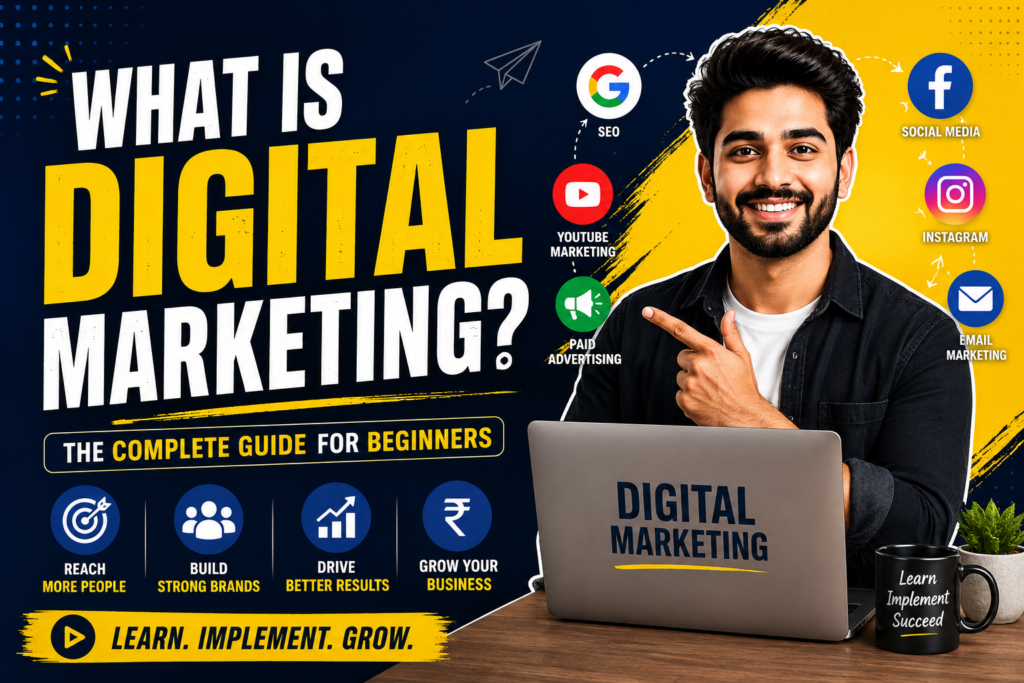
What Is Digital Marketing? A Complete Guide for Beginners
Digital marketing has become one of the most important parts of modern business. Whenever someone searches for a product on Google, watches a brand video on YouTube, sees an Instagram advertisement, receives a promotional email, or visits a business website, they may be interacting with digital marketing.
In simple terms, digital marketing is the promotion of products, services, brands, or businesses through digital channels and technologies. These channels include search engines, websites, social media, email, online advertising, mobile platforms, and other digital media.
Unlike traditional marketing, digital marketing allows businesses to reach specific audiences, measure campaign performance, collect useful data, and make changes based on results. It combines creativity, communication, technology, and data analysis.
For students, digital marketing can also be an interesting career field because it covers many different skills, from SEO and social media to Google Ads, content marketing and analytics. Institutes such as DGmark Institute can be one option for people who prefer structured, practical learning.
This guide explains what digital marketing means, how it works, its major types, benefits, tools, career opportunities, and how beginners can start learning it.
What Is Digital Marketing?
Digital marketing refers to marketing activities performed using digital channels and technologies to connect businesses with potential and existing customers.
A simple definition is:
Digital marketing is the process of promoting a product, service, brand, or business through digital channels to reach, engage, and convert a target audience.
These channels can include:
- Search engines
- Websites
- Social media
- Online advertisements
- Mobile applications
- Video platforms
- Content platforms
Cambridge Dictionary similarly describes digital marketing as marketing products or services through digital methods such as social media, email, search engines and websites.
For example, imagine a new restaurant opens in Mumbai. Instead of relying only on banners or newspaper advertisements, the restaurant could create an Instagram page, register its business on Google, publish its menu online, run Google Ads, create Reels, collect customer reviews and send offers to existing customers.
All these activities can form part of a digital marketing strategy.
The important thing to understand is that digital marketing is not simply posting on Instagram. It is a broad field involving multiple channels and strategies that work together to achieve business objectives.
⸻
How Does Digital Marketing Work?
Digital marketing usually starts with a business objective.
The objective could be:
- Increasing brand awareness
- Getting website visitors
- Generating leads
- Increasing online sales
- Getting app downloads
- Building a community
- Improving customer retention
Once the objective is clear, marketers identify the target audience and choose appropriate digital channels.
A basic digital marketing process can look like this:
Goal → Audience Research → Strategy → Content/Advertising → Traffic → Conversion → Measurement → Optimization
For example, suppose a digital marketing institute wants more students to enquire about its courses.
It could:
- Research students interested in digital marketing.
- Create educational blog content.
- Optimize the website for Google.
- Publish content on Instagram and YouTube.
- Run Google Ads.
- Run Meta Ads.
- Direct interested users to a landing page.
- Track enquiries.
- Analyze which campaigns perform best.
- Improve the campaigns.
This continuous process is important because digital marketing is not normally a one-time activity. Google describes it as a cycle involving planning, audience definition, content and channel activation, performance analysis, and continuous optimization.
⸻
Traditional Marketing vs Digital Marketing
Traditional marketing includes channels such as newspapers, magazines, television, radio, billboards and printed brochures.
Digital marketing uses digital platforms such as Google, websites, social media, email and online advertising.
Factor Traditional Marketing Digital Marketing
Medium TV, newspaper, radio, print Search, websites, social media, email
Targeting Usually broader Can be highly specific
Measurement Sometimes difficult Detailed measurement available
Interaction Mostly one-way Highly interactive
Optimization Often slower Can be adjusted quickly
Geographic reach Often location-focused Can reach local or global audiences
Budget flexibility Varies Campaigns can often be scaled
Data Limited compared with digital Extensive campaign data
This does not mean traditional marketing has become useless. Businesses can use both traditional and digital channels depending on their audience, industry and objectives.
For example, a local store could use outdoor advertising for visibility while also using Google Business Profile, Instagram and WhatsApp to communicate with customers.
⸻
Major Types of Digital Marketing
Digital marketing contains several different specializations. Businesses do not necessarily need to use every channel. The right combination depends on the target audience and business goals.
- Search Engine Optimization (SEO)
Search Engine Optimization, commonly called SEO, is the process of improving a website and its content to increase its visibility in organic search results.
Suppose someone searches Google for:
“Best digital marketing institute in Borivali”
If a relevant website appears in the unpaid search results, SEO may have contributed to that visibility.
SEO generally includes:
- Keyword research
- On-page SEO
- Technical SEO
- Off-page SEO
- Local SEO
- Content optimization
- Internal linking
- Website performance
SEO is generally a long-term strategy. Unlike paid advertising, businesses don’t directly pay a search engine for every organic click.
However, ranking organically requires useful content, technical optimization, authority and consistent effort.
⸻
- Search Engine Marketing and PPC
Paid search advertising allows businesses to display advertisements when users search for relevant terms.
Google Ads is one of the best-known platforms used for search advertising.
For example, someone searches:
“digital marketing course Mumbai”
A business can potentially show an advertisement for its course when that search occurs.
Important concepts include:
- Keywords
- Search campaigns
- Ad copy
- Bidding
- Landing pages
- Conversion tracking
- Cost per click
- Quality and relevance
Google describes search engine marketing as advertising that can show alongside search results based on keywords users search for.
PPC campaigns can provide faster visibility than SEO, but they require proper targeting, budget management and optimization.
⸻
- Social Media Marketing
Social media marketing involves using social platforms to build awareness, communicate with audiences, promote products and generate business results.
Popular platforms include:
- YouTube
- X
- Snapchat
Social media marketing can be divided broadly into:
Organic marketing:
Regular posts, Reels, videos, stories, community engagement and other unpaid activities.
Paid marketing:
Advertisements created through platforms such as Meta Ads.
A clothing brand, for example, might post styling videos on Instagram, collaborate with creators and run advertisements targeting people interested in fashion.
Social media is particularly useful for brands that depend on visual content and community engagement.
⸻
- Content Marketing
Content marketing focuses on creating and distributing useful content for a specific audience.
Examples include:
- Blog articles
- Videos
- Tutorials
- Guides
- E-books
- Infographics
- Case studies
- Social media posts
- Podcasts
The purpose isn’t always to make an immediate sale.
A business might first educate a potential customer, build trust and establish expertise. That person may then become a lead or customer later.
For example, a fitness company could publish articles about workout routines and nutrition. Someone searching for that information may discover the company through Google and eventually explore its products or services.
Good content marketing focuses on helping the audience, rather than simply promoting a product in every piece of content.
⸻
- Email Marketing
Email marketing involves communicating with customers or subscribers through email.
Businesses can use email for:
- Newsletters
- Product announcements
- Offers
- Educational content
- Customer updates
- Lead nurturing
- Automated communication
For example, an e-commerce website might send an email after someone abandons a shopping cart.
Another example is a digital marketing blog sending a weekly newsletter containing SEO tips.
Email remains useful because businesses can communicate directly with people who have chosen to receive their messages.
However, responsible email marketing requires appropriate consent, relevant content and sensible frequency.
⸻
- Affiliate Marketing
Affiliate marketing is a performance-based model where affiliates promote another company’s products or services and may receive a commission for qualifying sales or leads.
For example:
A blogger writes an article about laptops and recommends certain products using affiliate links.
A reader clicks the link and purchases a product.
Depending on the affiliate agreement, the blogger may receive a commission.
Affiliate marketing can benefit both businesses and publishers when the products are relevant to the audience and disclosures are handled appropriately.
⸻
- Influencer Marketing
Influencer marketing involves working with creators who have an established audience.
A brand might collaborate with:
- Instagram creators
- YouTubers
- Bloggers
- Industry experts
- Niche creators
The goal could be:
- Brand awareness
- Engagement
- Product discovery
- Website traffic
- Sales
Follower count alone should not determine whether an influencer is suitable.
Audience relevance, engagement, credibility and content quality can be equally important.
⸻
- Video Marketing
Video has become a major digital content format.
Businesses use platforms such as YouTube and Instagram to publish:
- Tutorials
- Product demonstrations
- Reviews
- Educational videos
- Short-form videos
- Behind-the-scenes content
- Customer stories
For example, a digital marketing institute could publish a video explaining how Google Ads bidding works.
Video can simplify complicated concepts and help brands communicate personality and expertise.
⸻
- Mobile Marketing
Mobile marketing focuses on reaching customers through mobile devices.
Examples include:
- SMS marketing
- Mobile applications
- Push notifications
- Mobile-friendly websites
- Mobile advertisements
- Location-based communication
Since many people access websites and social platforms primarily through smartphones, businesses need to make sure their digital experiences work properly on smaller screens.
A website that looks good on a desktop but is difficult to use on a smartphone can potentially lose customers.
⸻
- Performance Marketing
Performance marketing focuses heavily on measurable actions and outcomes.
Depending on the campaign, the desired action could be:
- Lead generation
- Purchase
- App installation
- Registration
- Website enquiry
- Subscription
Performance marketers regularly monitor data and adjust campaigns based on results.
Important metrics may include:
- CPC
- CPA
- Conversion rate
- ROAS
- Revenue
- Leads
This makes measurement an important part of performance marketing.
⸻
Why Is Digital Marketing Important?
Digital marketing is important because consumer behavior has changed significantly.
People use the internet to:
- Research products.
- Compare prices.
- Read reviews.
- Watch demonstrations.
- Discover brands.
- Communicate with businesses.
- Purchase products.
- Search for local services.
This creates opportunities for businesses to reach customers at different stages of their buying journey.
A customer might first discover a company through an Instagram Reel, later search its name on Google, visit its website, read a blog article and eventually make a purchase.
Digital marketing can connect these different interactions into a broader customer journey.
⸻
Benefits of Digital Marketing
- Wider Reach
A business can potentially reach people outside its immediate geographic area.
A Mumbai-based business can target customers in Mumbai, other Indian cities or even international markets depending on its business model.
- Better Targeting
Digital advertising platforms can offer targeting options based on factors such as audience characteristics, interests, behavior and search intent.
- Measurable Results
Businesses can monitor metrics such as clicks, traffic, conversions and advertising costs.
- Flexible Budgets
Digital advertising can often be started with controlled budgets and adjusted based on performance.
- Real-Time Optimization
Campaigns can be modified based on performance.
If one advertisement performs better than another, marketers can analyze why and adjust their strategy.
- Customer Engagement
Social media and other digital channels allow businesses to communicate directly with customers.
- Brand Awareness
Consistent digital presence can help people discover and remember a brand.
- Lead Generation
Websites, landing pages, advertisements and content can be used to generate enquiries.
⸻
Important Digital Marketing Channels
Channel Main Objective
SEO Organic search visibility
Google Ads Paid search and online advertising
Social Media Awareness and engagement
Content Marketing Education and audience building
Email Marketing Communication and retention
Affiliate Marketing Referral-based sales
Influencer Marketing Awareness and trust
Video Marketing Education and engagement
Performance Marketing Measurable business outcomes
The most effective strategy isn’t necessarily about using the largest number of channels. It is about selecting channels that match the audience and objective.
⸻
Important Digital Marketing Tools
Digital marketers use many tools to research, create, advertise and measure campaigns.
Google Analytics
Used to analyze website and user behavior data.
Google Search Console
Useful for monitoring a website’s presence and performance in Google Search.
Google Ads
Used to create and manage paid advertising campaigns across Google’s advertising ecosystem.
Google Keyword Planner
Can assist with keyword research and planning search advertising campaigns.
Meta Ads Manager
Used to create and manage advertising campaigns across Meta platforms.
Canva
Useful for creating social media graphics, presentations, advertisements and other visual content.
WordPress
A popular content management system used to create websites and blogs.
SEO Tools
Platforms such as SEMrush and Ahrefs provide various SEO and competitor research capabilities.
Email Marketing Platforms
Tools such as Mailchimp and other email platforms can help businesses manage email campaigns and subscriber communication.
The specific tools a marketer needs depend on their role. Google’s own digital marketing training, for example, covers tools including Canva, HubSpot, Mailchimp, Shopify, Google Ads and Google Analytics.
⸻
Important Digital Marketing Metrics
One major advantage of digital marketing is the ability to measure performance.
Impressions
The number of times content or an advertisement is displayed.
Reach
The number of unique people who see content or an advertisement.
Click-Through Rate (CTR)
The percentage of impressions that result in clicks.
Cost Per Click (CPC)
The amount paid for each click in a CPC advertising model.
Conversion Rate
The percentage of users who complete a desired action.
Cost Per Acquisition (CPA)
The cost associated with acquiring a customer or desired conversion.
Return on Ad Spend (ROAS)
A metric used to compare revenue generated with advertising spend.
Google identifies metrics such as CTR, website traffic, conversion rate, CPA and ROAS as useful measures for evaluating digital marketing performance.
⸻
Example of Digital Marketing for a Small Business
Consider a small café in Mumbai.
The café wants more customers.
It could create a Google Business Profile so that people searching for nearby cafés can discover it.
It could also:
- Create an Instagram page.
- Upload food photography.
- Publish Reels.
- Encourage genuine customer reviews.
- Create a website.
- Use local SEO.
- Run Meta Ads.
- Run Google Ads.
- Publish special offers.
- Build a customer database with appropriate permission.
Someone might discover the café through Instagram, search for it on Google, read reviews and then visit the location.
This example shows that digital marketing is not necessarily one isolated activity. Different channels can support different stages of the customer’s journey.
⸻
Digital Marketing for Students and Beginners
Digital marketing can be attractive to students because it includes many different areas.
A beginner might start with:
- Basic marketing concepts
- SEO
- Social media marketing
- Content writing
- Canva
- WordPress
- Google Ads
- Meta Ads
- Analytics
Over time, they can specialize.
For example, someone interested in search engines could focus on SEO.
Someone interested in advertising could specialize in Google Ads or Meta Ads.
Someone who enjoys creative work could focus on content and social media.
Someone interested in numbers and campaign performance might explore performance marketing and analytics.
This flexibility is one of the interesting aspects of the field.
⸻
Is Digital Marketing a Good Career?
Digital marketing offers several career paths, but it should not be treated as an instant-success career.
Common roles include:
Job Role Main Focus
Digital Marketing Executive Multiple marketing activities
SEO Executive Organic search
SEO Specialist Advanced SEO
Social Media Executive Social content and communities
PPC Executive Paid advertising
Performance Marketer Campaign performance
Content Marketer Content strategy
Email Marketing Specialist Email campaigns
Digital Marketing Analyst Data and reporting
Freelancer Marketing services for clients
Career growth depends on practical skills, experience, portfolio quality, communication ability and continuous learning.
A certificate can demonstrate learning, but practical experience and the ability to produce measurable work are also valuable.
Google’s India digital marketing certificate, for example, describes entry-level training across areas such as search, content marketing, email, analytics and e-commerce.
⸻
How to Learn Digital Marketing
There are several ways to learn digital marketing.
Step 1: Learn Marketing Fundamentals
Understand concepts such as:
- Target audience
- Customer journey
- Branding
- Positioning
- Conversion
- Marketing objectives
Step 2: Learn SEO
Understand keyword research, on-page SEO, technical SEO and off-page SEO.
Step 3: Learn Social Media
Practice creating posts, Reels, captions and content calendars.
Step 4: Learn Paid Advertising
Understand Google Ads and Meta Ads.
Step 5: Learn Analytics
Understand how to interpret traffic, conversions and campaign data.
Step 6: Build Websites
Learn basic WordPress and landing-page creation.
Step 7: Work on Projects
Create your own website, run small test campaigns where appropriate, perform SEO audits and build sample social media strategies.
Step 8: Build a Portfolio
A portfolio can demonstrate what you can actually do.
Students who prefer classroom-based structured learning can also consider a digital marketing institute such as DGmark Institute, while others may choose online courses, certifications or self-learning.
The important thing is not simply completing a course. The goal should be developing practical skills.
⸻
What Should You Look for in a Digital Marketing Course?
Before joining any digital marketing course, students should compare different options.
Consider:
- Course syllabus
- Practical assignments
- Trainer experience
- Live projects
- SEO training
- Google Ads
- Meta Ads
- Analytics
- WordPress
- Social media
- AI tools
- Internship opportunities
- Portfolio development
- Career guidance
- Course duration
- Fees
- Student reviews
Students should avoid choosing a course solely because of advertisements promising guaranteed jobs or unrealistic salaries.
Researching the curriculum and speaking to the institute before enrolling can lead to a better decision.
⸻
Digital Marketing and Artificial Intelligence
Artificial intelligence is increasingly becoming part of digital marketing workflows.
AI can assist marketers with:
- Content ideas
- Research
- Ad copy variations
- Email drafts
- Audience analysis
- Data interpretation
- Image creation
- Content planning
- Marketing automation
However, AI does not remove the need for human judgment.
A marketer still needs to understand:
- Customers
- Brand positioning
- Business objectives
- Creativity
- Ethics
- Data accuracy
- Campaign strategy
Google’s current digital marketing training also incorporates AI-related skills, including using AI for marketing strategy, research, campaign decisions, email content and copy variations.
The future marketer is therefore likely to benefit from knowing both traditional marketing principles and modern AI-assisted workflows.
⸻
Common Digital Marketing Mistakes
Beginners and businesses can make several mistakes.
- Not Defining the Target Audience
Trying to market to everyone can make communication less effective.
- Focusing Only on Followers
A large follower count does not automatically mean business success.
- Ignoring SEO
Businesses sometimes focus entirely on social media while neglecting search visibility.
- Poor Content
Posting frequently is not enough if the content provides little value.
- Not Tracking Conversions
Traffic and clicks are useful, but businesses ultimately need to understand whether marketing contributes to meaningful outcomes.
- Expecting Immediate Results
Some strategies, particularly SEO and content marketing, can require consistent effort over time.
- Copying Competitors
Competitor research is useful, but blindly copying another brand rarely creates a strong identity.
- Ignoring Data
Digital marketing generates data. Failing to analyze it means missing opportunities for improvement.
⸻
Future of Digital Marketing
Digital marketing continues to evolve as technology and consumer behavior change.
Some important areas include:
- Artificial intelligence
- Marketing automation
- Personalization
- Short-form video
- Creator marketing
- Data-driven advertising
- Conversational marketing
- Customer experience
- First-party data
- Search evolution
AI is particularly significant because it can help marketers analyze information, generate content variations and improve campaign workflows.
However, technology alone does not create successful marketing.
A strong understanding of customers, creativity, strategy and measurement remains essential.
⸻
Advantages and Limitations of Digital Marketing
Advantages Limitations
Global reach High competition
Detailed measurement Requires continuous learning
Flexible campaigns Platforms can change
Audience targeting Advertising can become expensive
Customer interaction Privacy considerations
Real-time optimization Results are not guaranteed
Multiple channels Requires proper strategy
Digital marketing offers significant opportunities, but it is not a magic solution.
Businesses still need good products, strong customer service, useful content and a clear strategy.
⸻
Frequently Asked Questions
What is digital marketing in simple words?
Digital marketing means promoting products, services or brands using digital channels such as Google, websites, social media, email and online advertising.
What are the main types of digital marketing?
Major types include SEO, search advertising, social media marketing, content marketing, email marketing, affiliate marketing, influencer marketing, video marketing, mobile marketing and performance marketing.
Why is digital marketing important?
It helps businesses reach people through channels they already use, while providing opportunities to target audiences, measure results and optimize campaigns.
Is digital marketing only about social media?
No. Social media is only one part of digital marketing. SEO, Google Ads, websites, email marketing, content marketing, analytics and other channels are also important.
Is digital marketing good for beginners?
Yes. Beginners can start by learning basic marketing concepts and then gradually develop skills in areas such as SEO, social media, advertising, content and analytics.
Is a digital marketing course necessary?
Not necessarily. Digital marketing can be learned through courses, certifications, practical projects, online resources and self-learning. A structured course can be useful for people who prefer guided learning.
How long does it take to learn digital marketing?
The basics can be learned relatively quickly, but becoming proficient requires continued practice. Digital platforms, tools and strategies keep changing, so learning is an ongoing process.
What tools do digital marketers use?
Common tools include Google Analytics, Google Search Console, Google Ads, Meta Ads Manager, Canva, WordPress and various SEO and email marketing platforms.
Can digital marketing be a career?
Yes. Career paths include SEO, PPC, social media, content marketing, performance marketing, analytics, email marketing and general digital marketing.
Can digital marketing help small businesses?
Yes. Small businesses can use local SEO, social media, websites, online advertising, content and customer communication to reach potential customers.
⸻
Conclusion
So, what is digital marketing?
Digital marketing is the use of digital channels and technologies to promote products, services, brands and businesses while connecting with potential and existing customers.
It includes much more than social media. SEO, Google Ads, Meta Ads, content marketing, email marketing, influencer marketing, video marketing, analytics and performance marketing are all parts of the wider digital marketing ecosystem.
One of its biggest advantages is measurability. Businesses can track activities such as impressions, clicks, website visits, leads, conversions and advertising costs. These insights can then be used to improve campaigns and make better marketing decisions.
For students and beginners, digital marketing offers multiple areas to explore. Some may enjoy SEO, while others may prefer advertising, social media, content, analytics or freelancing.
The best way to learn is through a combination of theory and practice. Building websites, creating campaigns, analyzing data and working on real or simulated projects can help turn theoretical knowledge into practical skills.
For learners looking for structured training, DGmark Institute is one option worth researching alongside other digital marketing institutes. Before choosing any course, students should compare the syllabus, practical training, projects, trainers, fees, internship opportunities and career support.
Digital marketing will continue to change as platforms, consumer behavior and AI develop. For anyone entering the field, the most valuable approach is therefore not simply learning today’s tools, but developing the ability to learn, test, analyze and adapt continuously.