
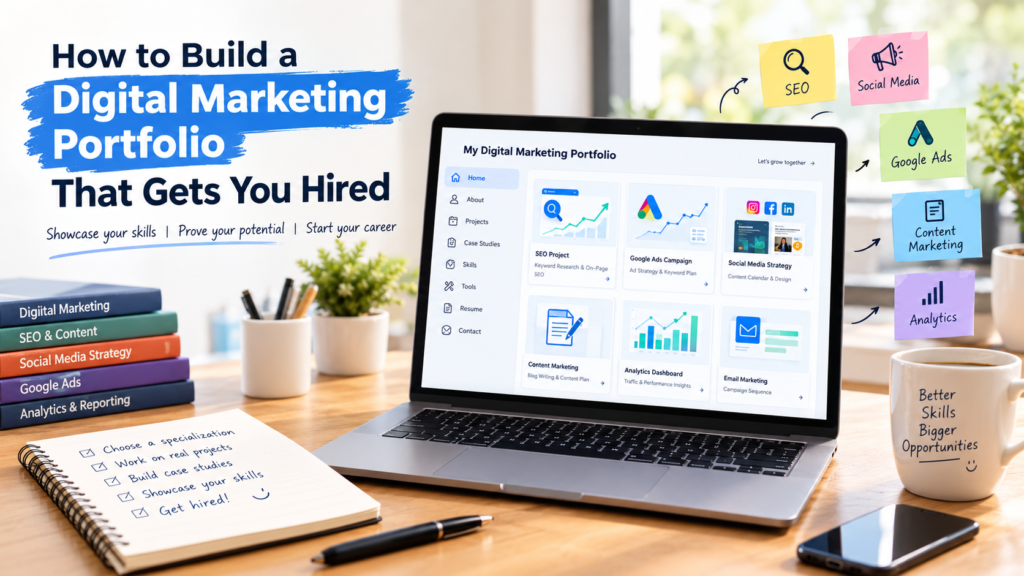
How to Build a Digital Marketing Portfolio That Gets You Hired
Third-party guest blog for digital marketing students, freshers, career switchers, and aspiring professionals
Introduction
Imagine applying for your first digital marketing job. You have completed a course, learned about search engine optimization, practised creating social media posts, and explored advertising platforms. You prepare your resume, mention your skills, and submit your application. However, when a recruiter asks, “Can you show me what you have done?”, you are unsure what to share.
This is a common challenge for students, freshers, and career changers entering digital marketing. Learning the concepts is important, but employers also want to understand how candidates apply their knowledge to practical situations.
That is where a digital marketing portfolio becomes valuable.
A portfolio gives you a place to showcase your work, explain your decisions, demonstrate your research, and communicate how you would approach marketing challenges. It can contain SEO audits, content plans, sample advertising campaigns, social media calendars, landing page recommendations, email marketing sequences, and analytics reports.
The good news is that you do not need years of professional experience to create one. You can start with practice projects, fictional business scenarios, your own website, or projects completed with permission for a real business. The key is to describe your work honestly and explain what it demonstrates.
Learning how to build a digital marketing portfolio is not simply about designing an attractive website. It is about creating evidence of your abilities and presenting that evidence in a way that is relevant to employers.
In this guide, you will learn how to choose your specialization, develop practical projects, write compelling case studies, select the right tools, organize your portfolio, and use it effectively when applying for jobs.
What Is a Digital Marketing Portfolio?
A digital marketing portfolio is a collection of work samples that demonstrates your marketing knowledge, practical skills, creative thinking, and ability to solve business problems.
It can be a personal website, a collection of case studies, a presentation, a PDF document, or an organized online folder. Its purpose is to help recruiters, hiring managers, and potential clients understand what you can do beyond the information listed on your resume.
For example, a resume might say that you know SEO, keyword research, and content optimization. Your portfolio can show a keyword research spreadsheet, a sample content strategy, an on-page SEO audit, and an explanation of why you recommended particular changes.
That difference matters because employers can review your approach rather than relying entirely on a list of skills.
What is the difference between a resume and a portfolio?
A resume summarizes your education, experience, skills, and qualifications. A portfolio demonstrates how you apply those skills.
Resume Digital marketing portfolio
Summarizes qualifications Demonstrates practical work
Lists skills and experience Shows examples of those skills
Usually follows a concise format Can include detailed case studies
Highlights responsibilities and achievements Explains objectives, research, decisions, and outcomes
Helps introduce you to employers Gives employers evidence to evaluate
The two work best together. Your resume should make a recruiter interested in your application, while your portfolio should help them understand the quality of your work.
What should a digital marketing portfolio include?
A strong beginner portfolio can include:
- A short professional introduction.
- Your main digital marketing skills and specialization.
- Three to five relevant projects, if available.
- Case studies explaining your process and decisions.
- Sample reports, screenshots, campaign plans, or content.
- The tools you have used and what you did with them.
- Your resume, professional profile, and contact information.
Quality matters more than quantity. Three carefully explained projects can communicate more than fifteen screenshots without context.
Why a Digital Marketing Portfolio Can Help You Get Hired
A portfolio can strengthen your job application because digital marketing combines strategy, creativity, analysis, and execution. Employers need to understand how you approach these different responsibilities. - It demonstrates practical knowledge
Knowing the definition of keyword research is different from carrying it out. A portfolio project can show how you identified search topics, grouped keywords according to intent, selected suitable content formats, and developed a content plan.
Similarly, knowing about social media marketing is not the same as developing a monthly content calendar with audience personas, content pillars, formats, and performance indicators.
Your portfolio connects theory with application.
- It helps employers evaluate your problem-solving skills
Digital marketing involves more than completing tasks. Professionals must understand a problem, research possible solutions, select an appropriate strategy, and measure performance.
For example, imagine a fictional local bakery wants to improve its online visibility. You could create a sample project covering local keyword research, Google Business Profile recommendations, website content improvements, and social media content ideas.
Even without actual campaign results, the project can demonstrate how you think through a marketing challenge.
- It makes interviews more specific
Instead of discussing your skills in general terms, you can walk an interviewer through a real or simulated project.
You can explain why you selected a particular audience, how you prioritized keywords, what challenges you encountered, and what you would measure after implementation.
This makes it easier to discuss your reasoning and acknowledge what you still need to learn.
- It can help you attract freelance clients
A portfolio is useful beyond full-time employment. Freelancers can use it to demonstrate their services and explain how they approach client problems.
A social media calendar, sample landing page audit, or SEO content strategy can help a prospective client understand the work involved in a project.
Make sure sample work is clearly identified as sample work. Never imply that a fictional project represents a paying client.
- It demonstrates initiative
For freshers, the biggest challenge is often a lack of professional experience. Creating relevant practice projects shows that you are willing to learn independently and apply your knowledge.
A portfolio cannot guarantee an interview or a job. However, when combined with relevant skills, a clear resume, good communication, and suitable applications, it can give employers more information to assess your potential.
Step 1: Choose Your Digital Marketing Specialization
Before building projects, decide which digital marketing skills you want to demonstrate. You can explore several areas, but your portfolio should have a clear direction.
Review job descriptions for entry-level positions and note the skills employers repeatedly request. Then select projects that demonstrate those skills.
Search Engine Optimization (SEO)
SEO focuses on improving a website’s visibility in organic search results. An SEO portfolio can demonstrate your ability to research keywords, understand search intent, improve website content, and identify technical or on-page issues.
Suitable projects include:
- Keyword research for a sample business.
- An SEO content calendar.
- An on-page SEO audit.
- A blog optimized around a specific search intent.
- A competitor content gap analysis.
Include screenshots, spreadsheets, and explanations of your recommendations. If you have access to a website you own or manage, you can also show verified Search Console data.
Social Media Marketing
Social media marketing requires planning content that fits a brand’s audience, goals, and communication style.
Your portfolio could include a 30-day content calendar, sample Instagram posts, short-form video concepts, audience personas, and a social media performance report.
Explain why you selected particular formats and topics. For instance, a local restaurant may benefit from menu highlights, customer education, behind-the-scenes content, and location-specific posts.
A content calendar should demonstrate more than creativity. It should connect each post to an objective, such as awareness, engagement, website visits, or enquiries.
Google Ads and PPC Advertising
Paid advertising requires a clear understanding of audience targeting, keyword selection, ad copy, budgets, conversion tracking, and performance measurement.
Create a mock campaign for a fictional business. Include the campaign objective, keyword themes, sample ads, landing page recommendations, proposed budget, and measurement plan.
Clearly label the project as a campaign proposal if you have not launched it. Do not present estimated clicks, conversions, or return on ad spend as actual campaign results.
Content Marketing and Blogging
Content marketing involves creating useful material that attracts, educates, and supports an audience.
Suitable portfolio projects include SEO blog articles, content briefs, topic clusters, editorial calendars, downloadable guides, and content refresh recommendations.
Show how you selected a topic, identified the intended audience, organized headings, and developed a clear call to action.
A strong content project demonstrates research, writing ability, search intent understanding, and the ability to explain complex ideas clearly.
Email Marketing
Email marketing projects can demonstrate your understanding of audience segmentation, subject lines, messaging, calls to action, and campaign objectives.
For example, create a hypothetical welcome email sequence for an online learning business. Include three emails: an introduction, a useful educational resource, and an invitation to explore relevant learning options.
Explain the purpose of each email and identify the metrics you would use to evaluate performance. Clearly distinguish your proposed sequence from a campaign that has actually been sent.
Web Analytics and Performance Marketing
Analytics helps marketers understand what happens after users interact with a website or campaign.
You can build a sample dashboard, analyze publicly available demonstration data, or prepare a measurement plan for a fictional business.
Show how you would interpret traffic sources, engagement, conversions, and campaign costs. Explain what additional information you would need before recommending changes.
For beginners, a useful strategy is to create projects across two or three related areas while developing deeper expertise in one specialization.
Step 2: Identify the Skills Employers Want to See
A portfolio becomes more persuasive when each project provides evidence of specific skills.
Instead of writing “I know SEO,” demonstrate how you performed keyword research, organized topics, or identified on-page issues. Instead of listing “Google Ads,” show a sample campaign structure and explain your targeting decisions.
Focus on these core abilities.
Keyword research and search intent: Demonstrate how you identify relevant search terms, group related queries, and match content to what users want to accomplish.
Content planning and copywriting: Show that you can develop clear headlines, informative articles, social posts, and persuasive calls to action for a defined audience.
SEO audits and optimization: Explain how you evaluate titles, headings, internal links, content structure, and other relevant website elements. Distinguish observable issues from assumptions that require further testing.
Social media strategy: Present audience personas, content pillars, platform choices, posting schedules, and measurement criteria.
Paid advertising: Show sample campaign structures, keyword groups, ad variations, audience assumptions, budget allocations, and conversion measurement plans.
Analytics and reporting: Demonstrate how you organize data, calculate relevant metrics, identify patterns, and communicate findings without overstating what the data proves.
Conversion optimization: Identify a potential obstacle on a landing page and recommend a testable improvement. Explain why the change might help and how you would evaluate its effect.
Communication: Present your work in a way that a non-technical manager can understand. Explain the problem, your approach, and the reasoning behind your recommendations.
The goal is to make every project answer one important question: what can you do, and how does your work demonstrate it?
Step 3: Build Digital Marketing Projects Without Work Experience
One of the biggest misconceptions about a digital marketing portfolio for freshers is that every project must come from a paying client.
That is not true. You can create practice projects that demonstrate your approach to realistic marketing challenges. The important requirement is transparency: label the work as a sample, simulation, personal project, or proposed strategy.
Here are eight projects you can start with.
Project 1: Keyword Research and SEO Content Plan
Choose a fictional business, such as a neighbourhood fitness studio, or use a website you own or have permission to analyze.
Start by identifying the business’s products, services, audience, and location. Research relevant search terms using suitable keyword research tools. Group the terms according to user intent and map them to potential website pages or blog topics.
Your deliverable should include a keyword spreadsheet with columns such as:
- Keyword or search topic.
- Search intent.
- Suggested content type.
- Target page.
- Priority and reasoning.
You can then prepare a content calendar showing the proposed topic, working title, audience, and objective for each article.
What it demonstrates: Research, search intent analysis, content planning, spreadsheet organization, and SEO fundamentals.
Do not invent search volumes or claim that your proposed content has already achieved rankings.
Project 2: An On-Page SEO Audit
Select a website you own or have permission to review. Alternatively, use publicly accessible information for a limited educational analysis without accessing private systems.
Review selected pages for title relevance, heading structure, content clarity, internal links, image descriptions, and alignment with likely search intent.
Record each observation alongside a recommendation and its rationale. Prioritize issues according to their potential relevance and the confidence of your assessment.
For example, if a page title does not clearly describe the page’s main subject, propose a more descriptive alternative and explain why it may help users understand the page.
Your final report can include a summary, screenshots, observations, recommendations, and limitations.
What it demonstrates: Attention to detail, SEO knowledge, research, prioritization, and written communication.
Remember that a manual review cannot establish every technical SEO issue. Avoid claiming to have checked server logs, private analytics, or indexing reports if you did not have access to them.
Project 3: A Sample Google Ads Campaign
Imagine a fictional business wants to generate enquiries for a service. Develop a campaign plan that explains how you would approach the objective.
Include:
- Business objective and target audience.
- Campaign structure and keyword themes.
- Proposed match types and negative keyword ideas.
- Sample headlines and descriptions.
- Location and audience assumptions.
- A hypothetical budget allocation.
- Suggested landing page improvements.
- Conversion tracking requirements.
- A measurement and optimization plan.
Explain how the proposed campaign would connect search intent to the landing page and conversion action.
For example, a user searching for a beginner digital marketing course may need different information from a user searching for a digital marketing agency. Your sample campaign should reflect that distinction.
What it demonstrates: Campaign planning, keyword selection, ad copywriting, budget awareness, and performance measurement.
Label the project as a mock campaign if it was never launched. A campaign plan is evidence of planning ability, not proof of advertising performance.
Project 4: A 30-Day Social Media Content Calendar
Choose a fictional brand and create a month-long social media plan.
Start with its business goals and target audience. Define three to five content pillars, such as educational tips, product information, customer questions, brand stories, and promotional content.
Prepare a calendar with the date, platform, format, topic, caption concept, call to action, and objective.
You can also create a few sample creatives using a design tool. Ensure that the visual style, language, and content formats are consistent with the fictional brand.
What it demonstrates: Content planning, creative thinking, audience understanding, brand consistency, and organization.
Include a proposed measurement plan covering reach, engagement, profile visits, link clicks, or enquiries, depending on the objective.
Project 5: An SEO-Optimized Blog Article
Write a blog article for a defined audience and search intent.
Your portfolio should include the chosen topic, primary keyword, related questions, suggested title, meta description, outline, article, internal linking suggestions, and a relevant call to action.
Explain why you selected the topic and how the article answers readers’ questions.
You can also include a short editorial checklist covering factual accuracy, readability, originality, and relevant sources.
What it demonstrates: Writing, keyword integration, content structure, audience research, and on-page SEO.
Do not claim that the article generated organic traffic unless you have real data from a published page and the appropriate measurement access.
Project 6: A Landing Page Audit
Choose a sample landing page or a website you are authorized to review.
Examine whether the main message is clear, the intended audience is identifiable, the offer is understandable, and the call to action is easy to find.
You can also assess the page’s information hierarchy, mobile presentation, form usability, and consistency between the advertisement or referral source and the landing page.
Prepare a report containing screenshots, observations, proposed changes, and the reasons for each recommendation.
What it demonstrates: User experience awareness, conversion thinking, copywriting, and structured problem-solving.
If you propose a new headline or form design, explain it as a recommendation to test rather than a proven improvement.
Project 7: A Sample Email Marketing Sequence
Create an email sequence for a fictional brand. For example, an online education business might welcome a new subscriber, provide a useful learning resource, and introduce relevant course information.
For every email, specify the target audience, objective, subject line, main message, call to action, and intended next step.
Explain how you would segment subscribers and measure campaign performance. Consider delivery, clicks, conversions, unsubscribes, and other appropriate indicators.
What it demonstrates: Copywriting, customer journey planning, segmentation, and measurement awareness.
Use fictional subscriber data only when clearly labeled, and do not send unsolicited messages to real people as part of your practice project.
Project 8: A Marketing Analytics Dashboard
Build a dashboard using sample data, a permitted dataset, or an official demonstration environment.
For example, Google’s Analytics demo account lets users explore GA4 features using demonstration business data. See the official Google Analytics demo account guide.
Create a dashboard that organizes relevant metrics such as traffic sources, sessions, engagement, key events, and conversions where those fields are available.
Add short observations explaining what the data suggests and what you would investigate next.
What it demonstrates: Data organization, analytical thinking, visualization, and the ability to communicate findings.
Clearly label the dataset’s origin and distinguish demonstration data from results generated by your own campaigns.
For every project, document the objective, process, tools, deliverables, limitations, and lessons learned. This turns a collection of assignments into a meaningful digital marketing portfolio.
Step 4: Create Strong Digital Marketing Case Studies
A case study explains not only what you created but also why you created it and how you approached the challenge.
Recruiters may see many portfolios containing attractive graphics or screenshots. A structured case study helps them understand the thinking behind the work.
Use this format for each featured project.
- Project title: Describe the project clearly.
- Background: Explain the business or scenario.
- Problem statement: Identify the challenge you are addressing.
- Objective: State what the project is intended to achieve.
- Target audience: Describe the intended users or customers.
- Research and strategy: Explain your findings and proposed approach.
- Implementation: Describe the work you completed.
- Tools: Identify the tools you used and how you used them.
- Results or expected outcomes: Present verified results or clearly labeled hypothetical expectations.
- Lessons learned: Explain what you would improve or investigate next.
Example: A fictional local bakery
Illustrative case study — hypothetical project, not a real client engagement.
Background: A fictional neighbourhood bakery wants more local customers to discover its products online.
Problem: The business has a basic website but no documented content strategy. The project assumes that its pages could communicate its products and local relevance more clearly.
Objective: Develop an initial organic visibility and content improvement proposal.
Research: Review the bakery’s product categories, intended audience, relevant local search topics, and the information customers might need before visiting.
Strategy: Organize product pages, propose useful content around bakery products and occasions, recommend clear business contact information, and prepare a local content calendar.
Implementation: Create a keyword map, draft an article outline, propose improved page titles, and prepare a four-week content plan.
Tools: A spreadsheet for keyword organization, a writing tool for content development, and a design tool for the presentation.
Results: The deliverable is a proposed strategy and a set of recommendations. No actual ranking or traffic improvement is claimed because the plan has not been implemented or measured.
Lessons learned: A more detailed project could include an authorized technical review, verified baseline data, implementation, and follow-up measurement.
This case study demonstrates strategic thinking without pretending that the fictional bakery is a real client. That honesty is part of a professional portfolio.
Step 5: Select the Right Tools for Your Portfolio
You do not need to master every marketing tool before creating your portfolio. Start with a small group that supports your chosen specialization, then expand as your projects become more advanced.
Tool How you can use it in a portfolio
Google Search Console Review search performance for a website you can access
Google Analytics Explore traffic and engagement data
Google Keyword Planner Research keyword ideas for advertising plans
Google Ads Prepare campaign structures and sample ads
Google Trends Explore relative interest in topics over time
Google Sheets or Excel Organize research, calendars, and reports
Canva Create social media creatives and presentations
WordPress Publish articles or develop a portfolio website
Meta Ads Manager Learn advertising campaign structure and reporting
Looker Studio Present marketing metrics in dashboards
Email marketing platforms Develop sample email sequences and learn campaign workflows
Availability, pricing, account requirements, and features vary by tool. You may be able to explore some functions through free access or demonstration environments, while other features require an account, a website you control, or an advertising setup.
How to demonstrate tool knowledge
Do not simply write “Google Analytics — advanced” on your portfolio if you have only explored its interface.
Instead, describe what you actually did. For example:
“Used a demonstration analytics dataset to organize traffic acquisition metrics, compare engagement patterns, and prepare a dashboard with observations and follow-up questions.”
This description is specific, credible, and easy to discuss during an interview.
For SEO projects, Google’s Search Console getting-started guide explains how site owners can begin working with the platform. You can use official documentation to support your learning and verify tool-specific details.
A useful rule is to select tools according to the work you want to demonstrate, rather than collecting tool names simply to make your portfolio look impressive.
Step 6: Choose a Platform to Showcase Your Portfolio
Your portfolio does not need an expensive website on the first day. Choose a format that makes your work easy to review and update.
Personal portfolio website
A personal website provides the greatest flexibility for presenting projects, case studies, professional information, and contact details.
It can be particularly useful if you plan to build a long-term career in digital marketing because the website itself can become a project demonstrating content organization, on-page SEO, and basic website management.
However, you will need to maintain the site and check that its links, pages, and mobile presentation work correctly.
Notion portfolio
Notion can be a convenient way to organize project pages, research notes, screenshots, and case studies.
It is useful for beginners who want to publish structured work without initially building a complete website. The presentation and publishing features available to you may depend on the platform’s current plan and settings.
Google Drive portfolio
A well-organized Google Drive folder can hold PDFs, spreadsheets, presentations, and reports.
Create a main portfolio document that links to selected projects. Check sharing permissions carefully so that recruiters can access the materials without requesting unnecessary access.
Avoid sending a folder containing private files, personal information, or unrelated documents.
PDF portfolio
A PDF is convenient for applications, email attachments, and interviews. It can provide a concise overview of your strongest projects in a consistent format.
Keep file size manageable, use readable text, include clickable links where appropriate, and ensure the document is accessible on different screen sizes.
A PDF should complement your online work rather than become an unnecessarily long collection of screenshots.
GitHub and LinkedIn
GitHub can be useful for technical SEO experiments, analytics scripts, data projects, and documentation. It is less essential for a portfolio that focuses entirely on social media creatives or writing.
LinkedIn can help you share your projects and professional background, but it should not be the only place where your work is organized. Link to accessible project pages or case studies so interested employers can explore them.
Which platform should a fresher choose?
Start with the platform you can maintain consistently. A simple website or organized Notion portfolio can be enough for your first few projects.
Once you have developed stronger work samples, you can build a more customized website. Do not delay your portfolio for weeks because you are trying to select the perfect design or platform.
Step 7: Organize Your Portfolio for Recruiters
A recruiter should be able to understand your main skills and find your strongest projects without navigating through a complicated website.
A clear structure might look like this:
- Home page: Introduce yourself, identify your main specialization, and provide a short summary of your capabilities.
- About me: Explain your background, career interests, and the areas of digital marketing you are learning or practising.
- Skills and specializations: List relevant skills and connect them to the projects that demonstrate them.
- Featured projects: Highlight your strongest work. Place the most relevant projects first instead of displaying every assignment equally.
- Case studies: Explain the context, objective, process, deliverables, and results or limitations of each project.
- Tools and certifications: Include relevant tools you have used and genuine qualifications you hold. Do not imply that familiarity with a tool is the same as a professional certification.
- Resume: Provide a current resume that matches your professional introduction and listed skills.
- Contact details: Give recruiters a clear way to contact you, such as a professional email address or LinkedIn profile.
Keep the design simple
Use consistent typography, readable headings, adequate spacing, and a clear visual hierarchy. Screenshots should support the explanation rather than overwhelm the page.
Check the website on a mobile device. Test navigation, downloadable files, images, and links. If you include a contact form, make sure it works.
Accessibility also matters. Use descriptive link text, sufficient contrast, meaningful headings, and alternative text for informative images.
Your portfolio should make reviewing your work easy. A complicated animation or elaborate design is not a substitute for relevant projects and clear explanations.
Step 8: Write Project Descriptions That Demonstrate Value
A project description should explain the purpose of the work, your contribution, and the reasoning behind your decisions.
One useful structure is problem, approach, and outcome.
- Problem: What challenge or question did the project address?
- Approach: What research, strategy, and tasks did you complete?
- Outcome: What did you produce, learn, or measure?
The outcome does not always need to be a numerical business result. For a practice project, the deliverable may be a completed content calendar, a documented audit, or a proposed campaign strategy.
Before and after: A social media project
Weak description:
“I created social media posts for a business.”
This tells the reader very little about the project’s scope or your contribution.
Improved description:
“Developed a 30-day social media content plan for a fictional local business, including audience personas, content pillars, post formats, publishing frequency, caption concepts, and engagement measurement criteria.”
The improved description explains what you created and which skills the work demonstrates.
Use specific language
Instead of writing “Worked on SEO,” explain the actual tasks:
“Prepared a keyword research spreadsheet, grouped queries by search intent, mapped topics to proposed website pages, and developed an SEO content calendar.”
If you worked with a team, clarify your individual contribution. If the project was completed for a real client, share only information you have permission to disclose.
Avoid vague descriptions such as “achieved amazing results” unless you can substantiate the claim. Clear explanations build more trust than exaggerated language.
Step 9: Add Metrics and Results the Right Way
Marketing metrics help explain whether a campaign or project is meeting its objectives. However, including numbers is useful only when you understand what they measure and where the data comes from.
Different marketing activities require different indicators.
Marketing area Useful metrics
SEO Impressions, clicks, click-through rate, rankings, organic conversions
Paid advertising Impressions, clicks, CPC, conversions, CPA, ROAS
Social media Reach, engagement, saves, shares, link clicks, leads
Content marketing Organic traffic, engagement, relevant conversions
Email marketing Delivery rate, clicks, unsubscribes, conversions
Definitions and reporting methods can vary by platform. For example, email open rates may be affected by privacy features, while advertising conversions depend on the configured attribution and tracking systems.
Understand the numbers before presenting them
Consider an illustrative paid advertising example.
A fictional campaign spends ₹5,000 and records 100 clicks. Its average cost per click is ₹50, assuming the stated spend and clicks cover the same reporting period and cost basis.
The calculation is:
[
\text{Average CPC}=\frac{\text{Advertising Spend}}{\text{Clicks}}
]
This example demonstrates a calculation, not a claim that a real campaign achieved those results.
If the campaign also recorded conversions, you could calculate conversion rate or cost per acquisition using the relevant definitions and verified data. But you should not invent conversions simply to make a project look successful.
For a sample project, use one of three approaches:
- Verified results: Use real data you are authorized to share.
- Hypothetical scenario: Clearly label all figures as illustrative assumptions.
- Proposed strategy: Describe expected measurement criteria without claiming results.
Include the reporting period, data source, project context, and any important limitations. If you have no numerical outcomes, explain what you created and what you would measure after implementation.
Honest reporting is a valuable professional skill in itself.
Step 10: Optimize Your Portfolio for Digital Marketing Jobs
A general portfolio can provide a useful foundation, but you should adapt the featured projects to the job you are applying for.
Read the job description carefully. Identify the most relevant responsibilities and place projects demonstrating those skills near the beginning of your portfolio.
For an SEO executive role
Prioritize keyword research, on-page SEO audits, content mapping, technical SEO observations, and search performance analysis where you have access to real data.
Explain your research process and distinguish confirmed technical issues from recommendations that require additional investigation.
For a social media executive role
Feature content calendars, creative samples, audience research, campaign concepts, caption writing, and reporting plans.
Demonstrate how you connect content formats and topics to specific objectives rather than producing posts without a strategy.
For a PPC executive role
Show campaign structures, keyword groupings, ad copy, budget assumptions, negative keyword ideas, landing page recommendations, and conversion tracking plans.
If you have actual campaign experience, include verified metrics where disclosure is permitted. Otherwise, label your work as a proposed or simulated campaign.
For a content marketing role
Highlight blog articles, editorial calendars, content briefs, topic clusters, and content improvement projects.
Explain how the work addresses audience needs and fits into a broader content strategy.
For a digital marketing analyst role
Prioritize dashboards, data cleaning, metric definitions, reporting examples, and explanations of your findings.
Show how you move from observations to questions and recommendations. Do not present correlation as proof of causation without adequate evidence.
Before submitting an application, check that your portfolio links work, your resume is current, and your examples are relevant to the role.
Step 11: Use Your Portfolio During Job Applications and Interviews
Creating a portfolio is only one part of the job search. You also need to make it easy for recruiters to find and understand your work.
Include your portfolio link in your resume
Place the link near your contact details or professional summary. Use a short, descriptive label such as “Digital Marketing Portfolio.”
If you have a personal website, you can also include it in the relevant section of your LinkedIn profile.
Share relevant projects with recruiters
When applying for an SEO role, share your strongest SEO work first. When applying for a social media position, highlight content planning and creative examples.
This helps the recruiter see the connection between your work and the role.
Prepare to explain every project
During an interview, be ready to answer questions such as:
- What was the objective of this project?
- How did you identify the audience?
- Why did you choose this strategy?
- Which tools did you use, and why?
- What information or assumptions were available?
- How would you measure success?
- What would you improve if you had more time?
- Which parts did you complete yourself?
- Was this a real client project, a personal project, or a simulation?
You do not need to know every answer immediately. It is better to acknowledge a limitation and explain how you would investigate it than to invent a technical explanation.
Follow up professionally
After an interview, you can send a brief thank-you message and mention a relevant project discussed during the conversation. Avoid repeatedly contacting recruiters or sending large files without considering their preferences.
A portfolio is most effective when it supports a clear professional story: what you know, what you have practised, how you approach problems, and what you want to learn next.
Common Digital Marketing Portfolio Mistakes to Avoid
A portfolio can contain excellent work and still fail to communicate your abilities if it is poorly organized or misleading. Before publishing, review these common mistakes.
- Claiming fictional work as client work. Practice projects are valuable, but they must be labelled correctly. State whether a project is personal work, a simulation, a proposed strategy, or a completed client engagement.
- Fabricating performance metrics. Never invent traffic growth, leads, conversions, revenue, or advertising results. If you have no verified results, explain the deliverables and measurement plan.
- Listing skills without evidence. Instead of writing that you are proficient in SEO, include a relevant audit, keyword research project, or content plan that demonstrates your knowledge.
- Including too many unrelated projects. Recruiters may struggle to identify your strengths if your portfolio contains every assignment you have completed. Prioritize your strongest and most relevant work.
- Using screenshots without explanations. A screenshot of an advertising dashboard or social media creative does not explain the strategy behind it. Add context, your contribution, and the purpose of the work.
- Ignoring mobile usability. A portfolio that looks good on a laptop but is difficult to navigate on a phone can create a poor reviewing experience.
- Sharing confidential information. Remove private client data, customer information, internal reports, and credentials. Obtain permission before publishing work completed for an employer or client.
- Copying other people’s work. Use original content, properly licensed assets, or materials you have permission to use. Attribute third-party resources where appropriate.
- Forgetting to update the portfolio. Review your featured projects periodically. Replace weaker examples as your skills improve, repair broken links, and remove outdated claims.
A professional portfolio does not need to be perfect. It needs to be relevant, clear, honest, and easy to review.
A 30-Day Digital Marketing Portfolio-Building Plan
If you are unsure where to begin, use this four-week plan. It is designed for someone who is studying or working alongside portfolio development.
Timeline Key activities Deliverables Goal
Week 1 Review job descriptions, choose a specialization, research project ideas Portfolio outline and project plan Establish direction
Week 2 Complete keyword research and one additional practical project Research spreadsheet and project deliverables Demonstrate core skills
Week 3 Write case studies, prepare screenshots, organize reports Two to four documented projects, depending on scope Explain your approach
Week 4 Publish your portfolio, check links, update your resume, apply for suitable jobs Live portfolio and application-ready resume Start your job search
Week 1: Plan your portfolio
Review job listings for entry-level positions in your chosen specialization. Note the skills employers request and identify projects that can demonstrate those skills.
Choose two or three manageable projects rather than attempting everything at once.
Week 2: Create your first projects
Complete a keyword research project and a second assignment, such as a social media calendar or sample advertising campaign.
Keep notes about your decisions, tools, assumptions, and challenges while working. These notes will make writing your case studies easier.
Week 3: Document and organize your work
Write project descriptions that explain the objective, process, deliverables, and limitations. Add relevant screenshots, tables, and sample reports.
Review each project to ensure that hypothetical data is labelled correctly and that you have permission to share any real work.
Week 4: Publish and apply
Choose your portfolio platform, organize your strongest projects, and check every link. Update your resume and professional profile with the portfolio link.
Begin applying for suitable roles and continue improving your portfolio based on the skills those roles require.
The purpose of the 30-day plan is to establish a practical foundation. You can continue adding projects as your experience develops.
How Digital Marketing Training Can Help You Build Practical Skills
Learning digital marketing involves understanding concepts, practising tools, applying strategies, and evaluating results. Structured training can help learners organize these activities and identify areas where they need more practice.
For beginners, useful learning activities may include keyword research exercises, SEO assignments, content planning, advertising campaign simulations, website analysis, and reporting projects.
Feedback can also help you identify mistakes that may be difficult to notice independently. For example, a review of your keyword research might reveal that you have grouped informational searches with transactional searches. Feedback on an advertising proposal might highlight a mismatch between the ad’s promise and the landing page.
When considering a training option, look beyond the course title. Review the curriculum, practical assignments, learning format, instructor information, available support, and opportunities to practise relevant skills. Confirm the details directly with the provider before enrolling.
Learners who want to explore structured digital marketing education can review the online digital marketing courses offered by DGmark Institute and assess whether the learning options align with their goals.
Training is one possible route to developing skills, but it does not replace independent practice. Whatever learning path you choose, focus on producing work samples that demonstrate what you understand and how you apply it.
Final Checklist Before Publishing Your Digital Marketing Portfolio
Use this checklist to review your portfolio before sharing it with recruiters.
Portfolio publishing checklist
0 of 12
[ ] Write a clear professional introduction.
[ ] Choose a relevant specialization and highlight your key skills.
[ ] Include at least three well-documented projects, where feasible.
[ ] Explain the objective and process behind each project.
[ ] Label sample projects and hypothetical data honestly.
[ ] Include relevant screenshots, reports, or case studies.
[ ] Identify the tools you actually used.
[ ] Check all links and contact details.
[ ] Test the portfolio on mobile devices.
[ ] Update your resume and LinkedIn profile.
[ ] Proofread your content and check image permissions.
[ ] Make it easy for employers to contact you.
Copy checklist
Conclusion: Build a Digital Marketing Portfolio That Shows What You Can Do
Learning how to build a digital marketing portfolio is an important step towards presenting yourself professionally in a competitive job market. A well-organized portfolio helps employers understand your skills, approach to problem-solving, creativity, and readiness to learn.
You do not need an impressive list of clients or years of experience to begin. Start with manageable projects, such as keyword research, an SEO audit, a social media calendar, or a sample Google Ads campaign. Explain your process, document your work, and be transparent about the results you have and have not achieved.
As you improve, tailor your featured projects to the roles you want and use feedback to strengthen your case studies. Keep learning, experiment responsibly, and update your portfolio as your skills develop.
Your first portfolio does not have to prove that you know everything. It should demonstrate that you can think carefully, apply what you have learned, communicate your decisions, and continue improving.
Choose your first project today, define its objective, and document each step. That is how you begin building a portfolio that gives employers a clearer picture of what you can contribute.